High shear mixing is how manufacturers make smooth emulsions, lump-free solutions and stable suspensions quickly and consistently. Sauces, creams, ointments, flavoured milks and coatings all depend on it. A high shear mixer does in minutes what a conventional agitator can take hours to do, or can’t do at all.
Most of the decisions come down to one question: which type of high shear mixer fits your process? This guide explains how high shear mixing works, compares the five main types, and shows how New Zealand manufacturers in food, dairy, cosmetics and pharmaceuticals choose between them. Advanced Packaging Systems (APS) is the exclusive New Zealand agent for Silverson high shear mixers, so the examples come from that range.
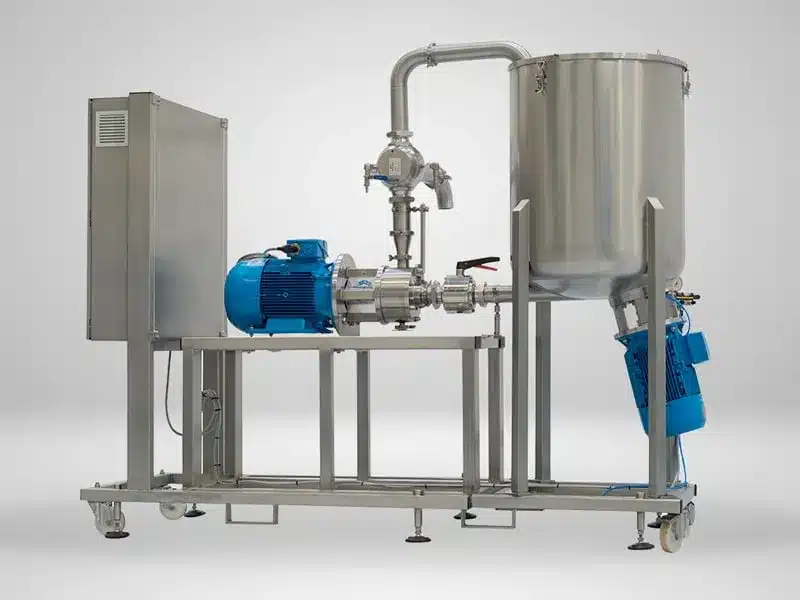
High Shear Mixers & Homogenisers
What High Shear Mixing Is
At the heart of every high shear mixer is a rotor turning at high speed inside a close-fitting stator. Together they form the workhead. The mixing happens in three stages:
- Suction. The spinning rotor draws liquid and solids into the centre of the workhead.
- Milling. Centrifugal force drives the material outwards, where it is milled in the narrow gap between the rotor tips and the stator wall.
- Hydraulic shear. The material is forced at high speed out through the openings in the stator and back into the mix, while fresh material is drawn in behind it.
That cycle is what lets one machine emulsify, homogenise, disperse, dissolve and disintegrate. A paddle or propeller simply moves the liquid around. Silverson reports that its mixers can cut processing times by up to 90% compared with conventional agitators. Interchangeable workheads and screens let the same mixer handle very different products.
The Five Types of High Shear Mixer Compared
The workhead principle is the same across the Silverson range. What changes is how the mixer is installed and how product reaches it:
| Type | How it’s installed | Scale | Best for |
|---|---|---|---|
| Batch mixer | Lowered into an open vessel on a floor stand, or mounted on the vessel | 5 to 30,000 litres | Flexible recipes, varying batch sizes, batch traceability |
| In-line mixer | Installed in a pipeline; product flows through it | Self-pumping, up to 20,000 litres an hour on general-duty models | Continuous production, closed processing, integration with other plant |
| Bottom entry mixer | Mounted through the base of a vessel | Vessels of 5 to 2,000 US gallons | Viscous products, and vessels with an anchor stirrer or scraper |
| Powder/liquid mixer (Flashmix) | In-line system that forces powder into the liquid stream | Powder incorporation up to 227 kg a minute | Large volumes of powder into liquid without lumps |
| Laboratory mixer (L5M-A) | Bench-top, on a stand | 1 ml to 12 litres, or in-line up to 20 litres a minute | R&D, QA, small-scale production and scale-up trials |
Each type has its own page with full specifications: Silverson batch mixers, Silverson in-line high shear mixers, Silverson bottom entry mixers, Silverson powder/liquid mixers and Silverson laboratory high shear mixers.

Silverson High Shear Lab Mixer
Batch or In-Line?
The choice between batch and in-line mixing is mostly about how your process is laid out, not about mixing quality. Both deliver high shear.
- Choose batch where recipes change often, batch sizes vary, or every batch needs its own traceability, as in pharmaceutical work and infant formula. The Silverson batch mixer post covers the range in detail.
- Choose in-line where you run one recipe for long periods at a steady flow rate, want to keep the product in a closed system, or need the mixer to feed straight into pasteurisers, heat exchangers or filling lines. See our article on in-line high shear mixers for how this works in practice.
Many plants use both: batch mixing for development and short runs, and in-line mixing for continuous production. Two further options sit alongside them. The bottom entry mixer handles viscous products from beneath the vessel. The ultra sanitary in-line range serves regulated pharmaceutical and biotech duties.

Silverson High Shear In-Line Ultra Hygienic Mixer
Viscous Products and Powders
Thick products and large powder additions are where a standard top-entry mixer struggles.
- Viscous products. A Silverson bottom entry mixer sits in the base of the vessel, often working with an anchor stirrer or scraper that keeps the whole batch moving. Models run from 1 HP to 40 HP, with 316L stainless steel wetted parts as standard.
- Powders into liquids. Adding powder to an agitated tank is slow and prone to lumps. The Silverson Flashmix forces powder directly into the high shear zone instead of relying on vacuum, so it keeps working at higher viscosities and temperatures. It also suits food, dairy and pharmaceutical duties.
Choosing by Industry
The right mixer depends as much on the product as on the plant. These articles cover the main New Zealand applications:
- Dairy. Recombining milk powders, flavoured milks and dairy desserts. See high shear mixing in dairy processing, and high shear mixing in yoghurt production for stabilisers and fruit preparations.
- Food emulsions. Dressings, sauces and mayonnaise need stable droplet sizes. See our article on consistent emulsification in food production.
- Cosmetics and personal care. Creams, lotions and gels, often with heat-sensitive ingredients. See high shear mixing in cosmetics and personal care manufacturing.
- Pharmaceutical and nutraceutical. Suspensions, emulsions and API dispersion, where traceability and hygiene drive the choice. See high shear mixing in pharmaceutical and nutraceutical manufacturing.
- Bakery and food waste. Turning off-spec product back into a usable ingredient. See high shear waste reclamation.

Silverson Ultra Mix Bottom Entry
Scaling Up from the Laboratory
Most high shear projects start on the bench. The Silverson L5M-A laboratory mixer has a digital tachometer, an amperage display and a programmable timer, and can log speed and power draw to a computer. Its results can be reproduced at production scale, so formulations developed in the lab carry through to the plant with less guesswork.
Our case study on enhancing face cream manufacturing shows how a lab-scale trial shaped a production process.
Hygienic and Sanitary Designs
In pharmaceutical, biotech and high-care food production, the mixer must not trap product where it can’t be cleaned or inspected. Silverson’s ultra sanitary in-line mixers are designed to meet 3-A and EHEDG hygienic design requirements and to comply with FDA and cGMP guidelines. Our guide to hygienic design and equipment certification explains what those standards mean for New Zealand processors.
Local Supply, Trials and Support
APS supplies, installs and supports Silverson high shear mixers across New Zealand. Trial loans are available on request, so you can test a mixer on your own product before committing. Our Silverson case studies, videos and technical data are a good starting point for comparing models.
Contact APS with your product, batch size or flow rate and viscosity, and we’ll recommend the right Silverson high shear mixer for your process.
Planning a processing or packaging project?
Speak with Advanced Packaging Systems about equipment selection, line integration, and local support in New Zealand.
- Local technical and commercial support in New Zealand.
- Obligation-free advice on equipment and line fit.
- Useful next steps, even if your project is still early-stage.
Frequently Asked Questions
What is a high shear mixer used for?
High shear mixers emulsify, homogenise, disperse, dissolve and disintegrate. Typical uses include making stable emulsions such as sauces and creams, dissolving gums and stabilisers, dispersing powders into liquids without lumps, and reducing particle size.
Is a high shear mixer the same as a homogeniser?
Not quite. A rotor-stator high shear mixer can homogenise many products on its own, and for some processes it removes the need for a separate homogenising step. For products that need very fine droplet sizes, it is often used as a pre-mixer ahead of a high-pressure homogeniser.
Should I choose a batch or an in-line mixer?
Choose batch for flexibility and batch traceability, and in-line for continuous production, closed processing and integration with other plant. Many manufacturers use both.
Can I trial a Silverson mixer before buying?
Yes. APS offers trial loans on request, including on the L5M-A laboratory mixer, so you can test performance on your own product.