

Choosing egg grading equipment comes down to three questions: how many eggs you need to handle in an hour, where the grading will happen, and what else the line has to do once the eggs are graded. A small free-range farm grading by hand and a national packing station grading 200,000 eggs an hour are solving the same problem at very different scales.
This guide walks through those questions for New Zealand producers. It covers what a grader actually does, the rules a grading room has to meet, how to match equipment to throughput, and the equipment that sits around the grader. Advanced Packaging Systems (APS) is the New Zealand partner for Moba, Nuovo and Meggson, so the examples come from those ranges, and the full specifications are on our Moba egg grading machines page.
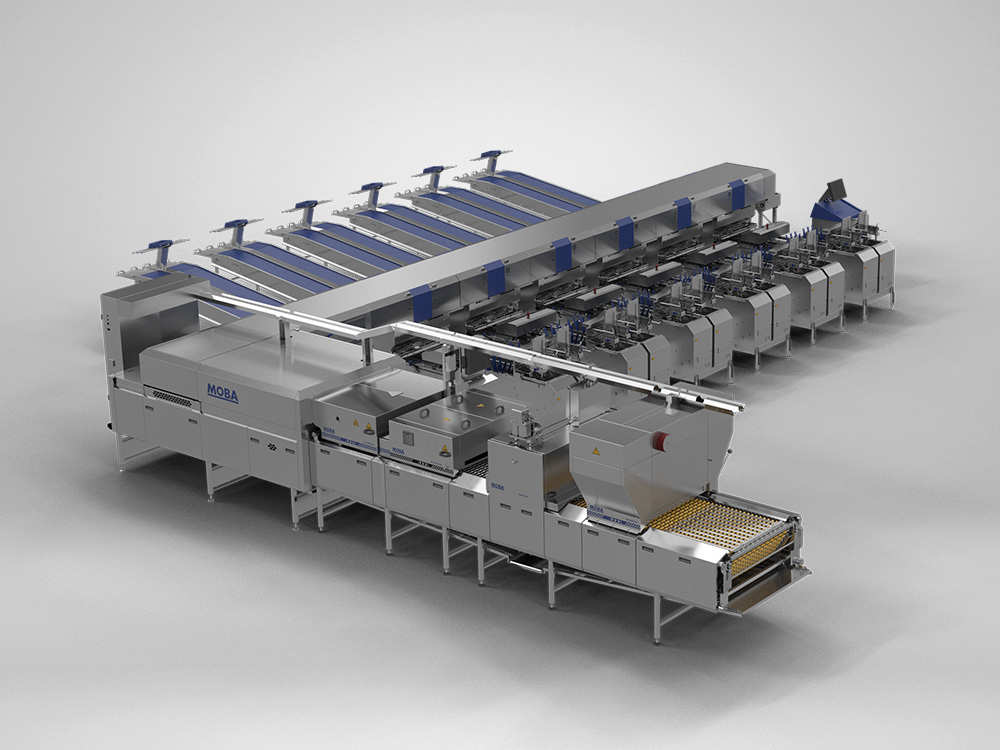
Moba Omina XF2 Egg Grader
What Egg Grading Equipment Does
An egg grader takes eggs from the farm and turns them into consistent, saleable packs. Whether the machine is manual or fully automatic, the same jobs are involved:
- Candling. Each egg is lit from below so the operator or a camera can spot cracks, blood spots and other defects.
- Weighing and grading. Eggs are weighed and sorted into size grades.
- Detection. Automatic graders add crack, leak, dirt and blood detection to protect food safety and lift the share of Grade A eggs.
- Packing. Graded eggs are placed into trays or consumer packs, ready for printing, labelling and dispatch.
An egg sorting machine and an egg grader are the same thing: both weigh and sort eggs and send them to the right packing lane.
In New Zealand, size grades are set by minimum weight per egg. The grades come from the Egg Producers Federation of New Zealand rather than from regulation:
| Grade | Name | Minimum weight per egg |
|---|---|---|
| Size 4 | Pullet | 35 g |
| Size 5 | Medium | 44 g |
| Size 6 | Standard | 53 g |
| Size 7 | Large | 62 g |
| Size 8 | Jumbo | 68 g |
Every grader in this guide can be set up for these grades. The manual Moba graders, for example, offer 4 or 7 grades.

Moba 68
The Rules a Grading Room Has to Support
Grading equipment is only part of compliance, but it has to make compliance easy. Three requirements matter most when choosing a machine:
- A registered programme. A business that harvests, candles, grades and packs whole-shell eggs must operate under a Risk Management Programme (RMP) under the Animal Products Act 1999. MPI publishes an RMP template for harvesting, candling or packing eggs. Equipment that is easy to clean and records what it does makes that programme easier to run.
- Labelling. Retail egg packs must carry the supplier’s name and street address, a best-before date, a nutrition information panel, a storage statement, and the number of eggs or the net weight. MPI’s labelling guidance sets out the detail, including how best-before dates are set.
- Traceability. Lot codes and dates on the pack, and increasingly on the egg itself, are how a producer traces a problem back to its source. That is the job of egg printing and stamping equipment, covered below.
Matching Equipment to Throughput
The single most important number is eggs per hour at peak lay. As a rule, size the equipment to your peak lay plus room to grow, so the grader does not become the bottleneck as the flock expands. The Moba range supplied by APS covers the whole span:
| Stage | Moba equipment | Capacity | Typical fit |
|---|---|---|---|
| Manual grading | Mobanette 3 | 1,600 eggs/hour, one operator | Small and starting farms |
| Manual grading | Moba 68 / Moba 88 | 3,000 / 4,500 eggs/hour | Medium farms, one or two operators |
| Farm packing | Mopack 40/55/70/100 | 14,400–36,000 eggs/hour | Placing eggs into trays on the farm |
| Farm packing | Mopack 150 | Up to 54,000 eggs/hour | Large farms |
| Automatic grading and packing | Forta GT | Up to 100 cases/hour | Growing operations |
| Automatic grading and packing | Omnia XF2, FT, PX | 45,000–255,000 eggs/hour | High-volume grading floors |
Capacity figures are from the APS product pages and the Moba sales brochures.

Nuovo Egg Stamper
Manual Egg Graders: Where Most Farms Start
For a small or new operation, a manual egg grader is the practical first step. The operator places eggs on the infeed, checks them over the candling lamp, and the machine weighs and sorts them into grades.
- Mobanette 3. A lightweight entry-level grader weighing 20.6 kg, with up to 1,600 eggs an hour, 4 or 7 grades and a single operator. It plugs into a standard wall socket.
- Moba 68. Up to 3,000 eggs an hour, built in stainless steel. The operator can switch between one-person and two-person working in seconds by moving the candling mirror.
- Moba 88. Up to 4,500 eggs an hour with two operators, with a tray table as standard.
Moba has supplied tens of thousands of these hand graders worldwide, and many large New Zealand operations started on one. Details are on our manual egg graders page.
Automatic Grading and Packing Stations
Once volumes outgrow hand grading, an automatic grading and packing station handles everything from infeed through detection, weighing and packing into consumer packs.
- Forta GT. Built around Moba’s individual egg handling, which keeps eggs from touching each other from the infeed onwards to reduce cross-contamination. It runs at up to 100 cases an hour and can be expanded with an egg inspector, crack detector and blood detector as the operation grows.
- Omnia XF2. Moba’s most widely installed series, from 45,000 to 255,000 eggs an hour, with an open-frame infeed that can be cleaned with foam and a high-pressure hose.
- Omnia FT. The same capacity range with clean-in-place infeed rollers, for hygiene-critical sites.
- Omnia PX. Aimed at the lowest total cost of ownership, with UV disinfection. Moba reports around 2% more Grade A yield.

Meggson TP100
Grading on the Farm or at a Packing Station
Not every farm grades its own eggs. Many place eggs into trays on the farm and send them to a grading and packing station. That makes the farmpacker one of the most important machines in the chain.
A farmpacker that handles eggs roughly can make a large difference to the number of cracked eggs, and over a year those breakages add up to a significant loss. Moba’s Mopack range keeps eggs apart once they are in the machine and keeps the flow continuous, so a missing egg leaves one empty gripper rather than stopping the cycle. Around the farmpacker, the Moba TS10 tray stacker stacks six trays at a time at up to 36,000 eggs an hour, and the MTW tray washer pre-soaks trays so they come clean in one pass.
At the packing station end, Meggson specialises in handling placed eggs, from depalletising trays as they arrive to palletising them again. Our article on Meggbots and Moba Mopack farmpackers shows how the two work together, and the farm packing, printing, stamping and palletising article follows a complete line.
Equipment Around the Grader
A grader rarely works alone. Three other pieces of equipment are worth planning at the same time:
- Egg printing and stamping. Nuovo systems print dates, lot codes and logos onto eggs, either as stand-alone machines or inline on graders and farmpackers. The Easy Stamp R6 uses 600 dpi screen-print stamping, and the Egg Jet Printer R6 prints inline on Mopack farmpackers with automatic date functions. Our guide to Nuovo egg printers and stamping systems covers the range.
- Placed-egg handling. Meggson depalletising and palletising equipment takes the heavy lifting out of moving trays of eggs in and out of the grading room.
- Liquid egg processing. For eggs that are not sold in the shell, the Moba Ovolution is a complete liquid egg processing system that breaks, blends, pasteurises and packs, at 300 to 2,000 litres an hour.

Meggbot TP100
Working Out the Real Cost
The purchase price of a grader is only a small part of what it costs to grade eggs. Moba’s view is that three factors make up 80 to 90% of the cost of modern grading and packing: packaging, labour, and losses through the process. A machine that reduces breakages, needs fewer people and packs efficiently can be worth far more than its price difference suggests.
When comparing machines, look past the headline capacity to efficiency, yield, uptime and residual value. The price itself depends on capacity, the number of packing lanes and the detection options, so a firm quote needs those decisions made first.
Grading for Export
Export markets often ask more of a grading line than the domestic market does, from tighter quality checks to fuller traceability. Our article on egg grading for export to Asian markets covers what those buyers look for. Closer to home, our case study on Ah Liki Wholesale in Samoa shows a Moba line set up for a Pacific operation.
Service and Support in New Zealand
Grading equipment runs every day of the laying cycle, so local support matters as much as the machine. APS supplies, installs and services Moba equipment across New Zealand, with technicians and parts held locally from our Auckland base, so producers are not left waiting on support from overseas.
Our article on why Moba solutions suit New Zealand egg producers explains what local backing means in practice.
Contact APS to talk through your throughput, your grading room and your plans for growth, and we will recommend the right egg grading equipment for your operation.
Frequently Asked Questions
How much does egg grading equipment cost?
It depends mostly on capacity, the number of packing lanes and the detection options. A manual Mobanette 3 and a 255,000 egg-per-hour Omnia line are very different investments, so APS scopes the equipment to your throughput and provides an itemised quote.
What is the smallest egg grading machine?
The Mobanette 3 is the entry point in the Moba range: a manual grader of 20.6 kg that handles up to 1,600 eggs an hour with one operator.
What size grader do I need?
Start from your eggs per hour at peak lay, then add room for growth. If the flock is likely to expand, a grader that can take extra detection modules or packing lanes later, such as the Forta GT, avoids a second purchase.
Can one machine grade and pack eggs?
Yes. The Forta GT and the Omnia range are complete grading and packing stations, from infeed through detection and weighing to consumer packs. Manual graders grade, and the operator packs.
Planning a processing or packaging project?
Speak with Advanced Packaging Systems about equipment selection, line integration, and local support in New Zealand.
- Local technical and commercial support in New Zealand.
- Obligation-free advice on equipment and line fit.
- Useful next steps, even if your project is still early-stage.