Stainless steel conveyor belts carry product through some of the hardest conditions on a food processing line: oven heat, freezer cold, constant washdown and cleaning chemicals, shift after shift. Choosing the right one comes down to a handful of questions. What does the product need from the belt surface? What temperature does the belt run at? How will it be cleaned? How will it be driven?
This guide works through those questions for New Zealand processors. It covers why stainless steel is used instead of plastic, the main belt types and where each fits, how to match a belt to the process stage, and the specification details that matter when ordering. Advanced Packaging Systems (APS) is the exclusive New Zealand agent for Wire Belt, so the examples come from that range. The full line-up is on our Wire Belt conveyor belts page.

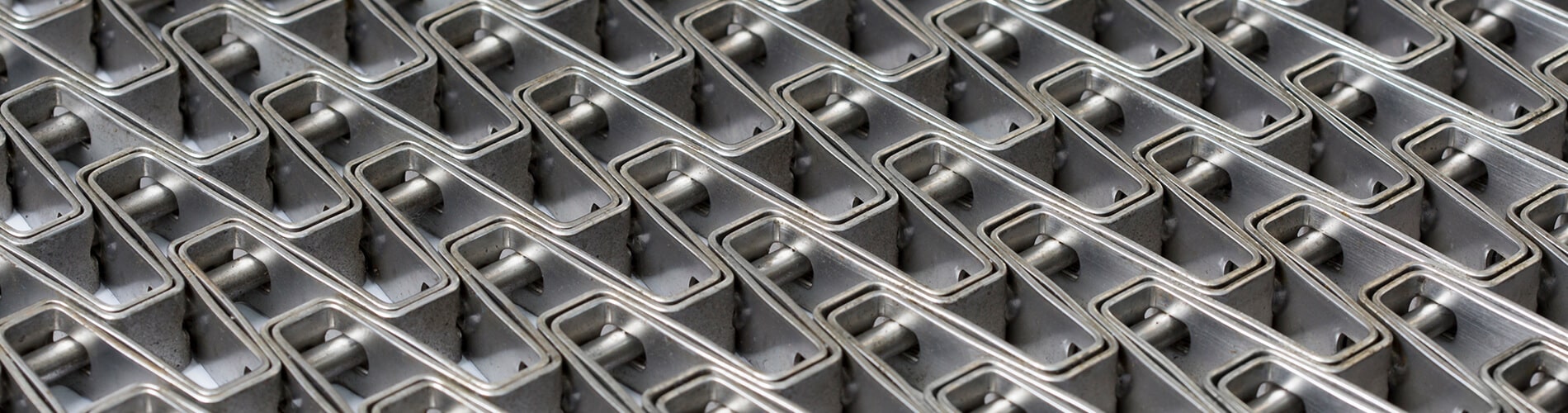
Wire Belt Ladder Conveyor Belt
Why Stainless Steel Instead of Plastic
Plastic modular belting is common and has its place, but stainless steel conveyor belts have advantages that matter in food production:
- Temperature range. The same family of belts can run in tunnel ovens and in freezing tunnels. Stainless steel doesn’t soften with heat or turn brittle in the cold.
- Open area. Wire mesh can be very open. Flat-Flex® reaches up to 86% open area in some configurations, so air, heat and wash water move straight through the belt and around the product.
- Cleanability. There are no enclosed hollows or hinge pockets for residue to hide in, and the whole belt surface can be seen and checked after cleaning. Wire Belt cites testing in which Flat-Flex® was at least 10 times, and in some cases more than 100 times, cleaner than a plastic modular belt.
- Strength and life. Stainless steel belts carry heavy loads without stretching or sagging. They usually cost more to buy than plastic, but last longer and need replacing less often.
- Recyclability. At the end of its life, a stainless steel belt can be recycled.
Our comparison of wire mesh and plastic modular belts goes into the hygiene evidence in more detail.
Stainless Steel Conveyor Belt Types Compared
Wire Belt makes a wide range of belt styles. These are the ones New Zealand food processors use most:
| Belt | Construction | Drive | Typical uses |
|---|---|---|---|
| Flat-Flex® | Open flat-wire mesh, up to 86% open area | Positive | Baking, cooling, freezing tunnels, coating, general food handling |
| Compact-Grid™ | Fine low-mass mesh, 10 mm pitch, 70% open area | Positive | High-speed lines, small products, tight transfers, allergen-sensitive production |
| Eye-Flex® | Heavy-duty modular wire links, 15.875–100 mm pitch | Positive | Heavy loads, ovens, fryers, washers, freezing tunnels |
| Honeycomb | Flat-wire, rigid open construction | Positive | Washdown conveyors, drainage tables, heavier or uneven loads |
| Balanced Spiral and Cordweave | Woven balanced weave; Cordweave is a dense compound version | Mostly friction | General conveying, baking, small products that need a tight, flat surface |
| Ladder-Track™ | Simple open ladder construction | Positive | Bakery cooling conveyors, light products |
| Rolled Baking Band | Solid, smooth surface rolled from woven mesh | Friction (drum) | Biscuit, cookie and cracker tunnel ovens |
The sections below cover where each one fits, and each belt has its own article with full specifications.

Wire Belt Flex Turn
Choosing a Belt by Process Stage
Food and Dairy Hygiene
Wherever product sits directly on the belt and the line is cleaned every shift, hygiene usually decides the choice. Our guide to food-grade conveyor belts covers what makes a belt food-grade, how to clean it, and how belts are used in cheese, butter, yoghurt and liquid dairy lines.
Baking and Tunnel Ovens
Biscuit and cracker ovens often use a solid surface. The Rolled Baking Band is installed in tunnel ovens over 100 metres long, with baking zones up to about 310°C. Products that are small or delicate, or that need a tight, flat surface with some airflow, suit compound balanced weave belts such as Cordweave. Open belts such as Flat-Flex® are used where heat needs to reach the product from below.
Cooling and Freezing Tunnels
Cooling and freezing depend on air reaching every side of the product. High open-area belts such as Flat-Flex® and Compact-Grid™ let chilled air flow straight through. Eye-Flex® with spring spacers holds its shape through repeated freeze–thaw cycles, which suits blast freezers and freezing tunnels.
Washdown and Wet Processing
Washers, drainage tables and wet processing lines need a belt that drains freely and stays on track under load. The Honeycomb range of flat wire conveyor belts runs on a positive sprocket drive and is built for exactly this kind of duty.
High-Speed Lines and Allergen Control
Small products on fast lines need a fine mesh and tight transfers. The Compact-Grid™ conveyor belt has a 16 mm minimum transfer diameter and runs at up to 45.7 metres a minute. Its open construction is quick to clean between allergen changeovers.
Heavy Loads
For heavy or bulky products, Eye-Flex® modular conveyor belts are built from interlocking wire links in a wide range of pitches and wire sizes. Spacer options let the gap between links be set to suit the product and the process.
Spreading and Line Balancing
Where product needs to be spread across a wider belt, brought together or split between lanes, a spreader conveyor such as the Ladder-Flex™ uses positively driven stainless steel belt strands to keep product positioned accurately.

Wire Belt Eye Flex
Specification Basics
A few details decide whether a belt performs well on a particular line:
- Stainless steel grade. Wire Belt uses Grade 302 stainless steel (EN 1.4310) as standard for spring-tensioned open-mesh belts such as Flat-Flex® and Compact-Grid™. Grade 302 has more carbon than 304, which gives the wire higher tensile strength and spring, so the belt holds its shape around tight transfer rollers. Heavier woven and flat-wire styles such as Ladder-Track™, Honeycomb and Cordweave use Grade 304 (EN 1.4301), which is slightly more corrosion resistant and easier to weld and form. Grade 316 and specialist heat-resisting grades are available for corrosive or very hot duties.
- Open area and mesh. More open area means better airflow, drainage and cleaning access, but small or fragile products may need a tighter mesh so they don’t catch or fall through.
- Positive or friction drive. Positively driven belts are moved by sprockets that engage the mesh, which reduces slippage and keeps the belt tracking straight. Friction-driven belts are moved by rollers or drums and suit long, simple runs such as oven bands.
- Temperature. Wire strength falls as temperature rises, so the wire grade has to suit the hottest part of the process as well as the coldest.
- Transfers and edges. The smallest transfer diameter a belt can run around, and the edge finish, affect how cleanly product moves between conveyors.
Hygiene and Cleaning
Stainless steel mesh belts suit clean-in-place routines. Cleaning solution can reach the top, the underside and the support structure without the conveyor being dismantled. Some positively driven belts can even be cleaned while running at reduced speed. Where a plant has to meet a recognised hygienic design standard, our guide to hygienic design and equipment certification explains EHEDG, 3-A and the other schemes New Zealand processors come across.
Spiral Freezers
When a plant needs a long freezing time but has little floor space, a straight freezing tunnel may not fit. A spiral freezer solves this by winding the belt into a vertical spiral, so product travels up through the cold zone tier by tier. A belt path that would need tens of metres of straight conveyor fits into a fraction of the footprint.
APS supplies spiral freezers and spiral freezer belting from Ashworth. Our article on spiral conveyor systems for food freezing explains how a spiral works and covers Ashworth’s SpiralSurf® Edge Drive.

Ashworth Spiral Freezer
Replacement Belts and Local Support
Many conveyor belt enquiries are for replacements: a belt has worn, stretched or been damaged, and the line needs to be running again. APS specifies Wire Belt belting to your conveyor’s dimensions, supplies like-for-like or upgraded replacements, and provides local servicing support. That means you aren’t dealing with an overseas supplier.
Our Wire Belt FAQ answers common questions about joining, maintenance and the causes of belt failure. For conveyors and complete transfer systems beyond the belt itself, see our hygienic conveyor systems page.
Contact APS with your product, process temperatures and conveyor dimensions, and we’ll recommend the right stainless steel conveyor belt for your line. We can also review stainless steel conveyor belts already in service.
Frequently Asked Questions
What is a food-grade conveyor belt?
A food-grade conveyor belt is made from materials that are safe for direct food contact and can be cleaned to a verifiable standard. Stainless steel wire mesh meets both requirements: it is non-porous, resists cleaning chemicals, and has no fabric or adhesive layers to trap moisture.
Is a wire mesh belt better than a plastic modular belt?
For hot, cold or heavily cleaned processes, usually yes. Wire mesh handles a wider temperature range, offers more open area and is easier to inspect after cleaning. Plastic modular belting can still suit some ambient packaging and handling duties.
What is the difference between 302 and 304 stainless steel belts?
Grade 302 has higher carbon content, which gives the wire more tensile strength and spring. Wire Belt uses it for spring-tensioned mesh belts such as Flat-Flex® and Compact-Grid™. Grade 304 is slightly more corrosion resistant and easier to weld and form, so it is used for heavier woven and flat-wire belts such as Honeycomb and Cordweave.
Can I get a stainless steel conveyor belt made to size in New Zealand?
Yes. APS specifies and supplies Wire Belt belting to your conveyor’s width, length and drive arrangement, for new lines and replacements.
Planning a processing or packaging project?
Speak with Advanced Packaging Systems about equipment selection, line integration, and local support in New Zealand.
- Local technical and commercial support in New Zealand.
- Obligation-free advice on equipment and line fit.
- Useful next steps, even if your project is still early-stage.