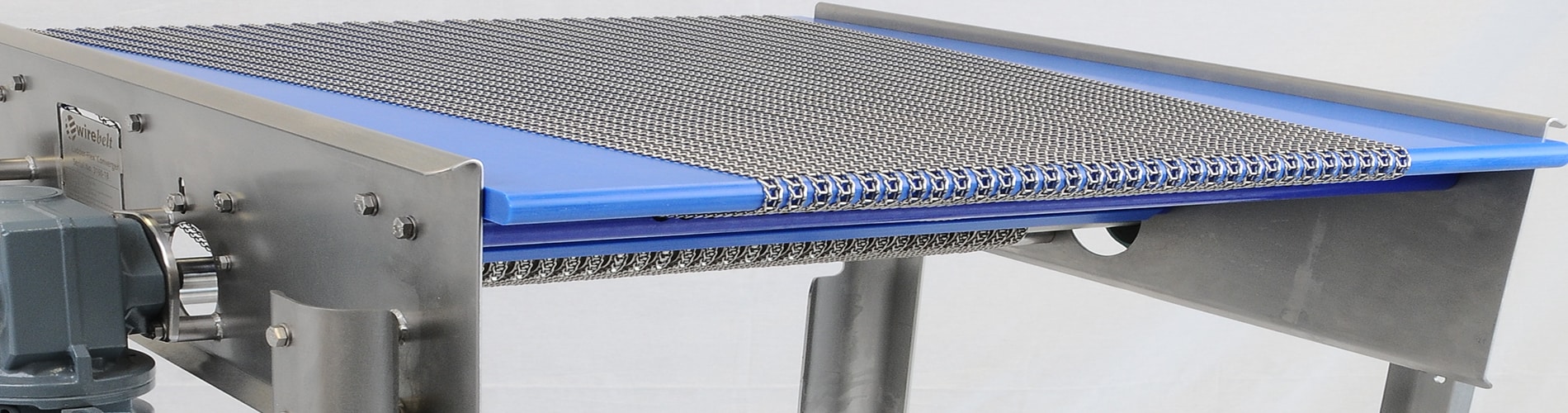
Wire Belt’s Ladder-Flex™ is a positively driven spreader, converger and diverger built for food, confectionery and industrial applications. Advanced Packaging Systems supplies and supports the Ladder-Flex™ range across New Zealand.
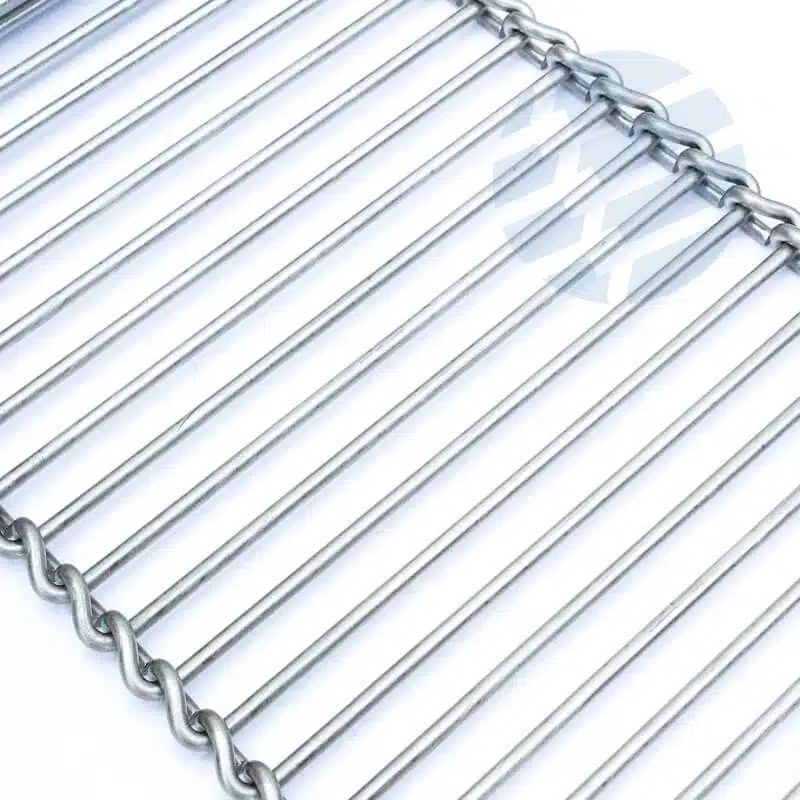
Ladder Track Conveyor Belt
What is a spreader conveyor?
A spreader conveyor, also described as a spreading, gapping or lane-divider conveyor, is a transfer conveyor designed to change the spacing or lateral position of products while they keep moving along the line. Rather than simply carrying product from one point to the next, it actively spreads items apart, brings them together (converging), or moves them across the width of the belt (diverging).
The aim is a predictable, evenly spaced flow that downstream equipment can handle reliably. Consistent spacing lets processors run narrower upstream conveyors, saving valuable factory floor space, and benefits coating and enrobing processes by separating product to give full surface coverage and reduce rejection rates.
How the Wire Belt Ladder-Flex™ works
The Ladder-Flex™ Model 200 uses rows of Ladder-Flex™ stainless steel belting running over a high-density, food-grade polyethylene support surface, driven by a series of small stainless steel sprockets that engage within the mesh of the belt strands. This delivers a non-slip, positive drive: product is moved by the belt itself rather than relying on friction, so positioning stays accurate even with lightweight or delicate items.
Because the product is fully supported across the conveyor surface and each unit is custom built to suit the product being handled, the Ladder-Flex™ is well suited to fragile and irregularly shaped goods that would be damaged or mispositioned by conventional belt or roller conveyors.

Wire Belt Ladder Conveyor Belt
Spreading, converging and diverging configurations
The Ladder-Flex™ is configured to match the product-positioning task:
- Fan-type (standard) – a fan arrangement that positions product evenly on either side of the conveyor centreline, spreading or converging symmetrically.
- Lane-type – chains arranged into individual lanes to spread or converge product from specific infeed positions, giving consistently spaced rows.
- Custom – other layouts to meet specific positioning needs; for example, the left edge can remain constant while product spreads towards the right.
Individual chains can handle randomised product, while grouped lanes of chains produce regularly spaced output – the configuration is chosen around how product arrives and how the next process needs to receive it.
Why product spacing matters for pick and place and automation
Automated systems struggle when products overlap or sit too close together: vision systems cannot identify each item cleanly, grippers risk catching neighbouring product, and throughput drops. By establishing reliable spacing and orientation before the automation cell, a spreader conveyor makes each item easier to detect, easier to pick without interference, and easier to move smoothly through the system – better spacing means better performance, without slowing the line.
In practice this means fewer jams, misfeeds and rejects, more consistent packaging and inspection accuracy, and a robotic or vision-guided cell that can run at its rated speed because it receives product at a known pitch.
Planning a processing or packaging project?
Speak with Advanced Packaging Systems about equipment selection, line integration, and local support in New Zealand.
- Local technical and commercial support in New Zealand.
- Obligation-free advice on equipment and line fit.
- Useful next steps, even if your project is still early-stage.
Applications across food, confectionery and industrial processing
Ladder-Flex™ conveyors are used wherever lightweight or delicate products need separating, aligning or grouping – commonly in bakery and baked goods, confectionery, and protein and meat processing, as well as general industrial lines feeding packaging, inspection or robotic pick-and-place equipment.
A representative example is a high-speed ice cream production line, where a global end-of-line packaging automation specialist needed to spread product cleanly into a robotic secondary-packaging cell within a tight space. Wire Belt engineered a custom Ladder-Flex™ with a gentle 10-degree decline and a reduced-width frame to fit the line, resolving the product-flow irregularities that had been disrupting downstream robotic operations.
Hygienic design and easy cleaning
The Ladder-Flex™ is designed to the latest EHEDG (European Hygienic Engineering and Design Group) conveyor design guidelines. Open-frame construction in stainless steel and UHMW-PE makes it straightforward to clean and well suited to hygiene-sensitive food environments, while its simple mechanical design means fewer parts to maintain. Standard drive motors and controllers are supplied with IP66 enclosure protection and OS2 surface protection on the drive motor, making the conveyor suitable for intensive washdown processes.
Ladder-Flex™ specifications
| Feature | Ladder-Flex™ Model 200 |
|---|---|
| Function | Spreading, converging and diverging of product on the line |
| Belting | Ladder-Flex™ stainless steel belt strands, positively driven – non-slip |
| Drive | Series of small stainless steel sprockets engaging within the belt mesh |
| Support surface | High-density, food-grade blue polyethylene (UHMW-PE); product fully supported across the surface |
| Frame | Stainless steel |
| Belt speed | Up to 25 metres per minute (faster applications on request) |
| Working height | Height adjustable, standard 870–1070 mm |
| Drive protection | IP66 enclosure; OS2 surface protection on drive motor – suitable for intensive washdown |
| Speed control | Variable-frequency drive (VFD) for stop/start and speed; stainless control panel with emergency stop, or Invertek E3 Optidrive |
| Mounting | Height-adjustable footpads as standard; lockable swivel castors with brakes optional |
| Configurations | Fan-type, lane-type or custom (e.g. constant left edge with spread to the right) |
| Options | Inclining/declining frames; alternative drive units |
Customisation, integration and support in New Zealand
Every Ladder-Flex™ is built around the application. Inclining and declining frames, alternative drive units, VFD speed control and a choice of footpads or lockable swivel castors allow the conveyor to be tailored to the product and the available footprint, and to integrate cleanly with upstream and downstream equipment – including pick-and-place and robotic systems – thanks to tight transfers with adjacent conveyors.
As the New Zealand agent for Wire Belt, Advanced Packaging Systems is the local point of contact for specifying, supplying and supporting Ladder-Flex™ spreader conveyors, from initial application review through to installation and commissioning.
Frequently asked questions
What is a spreader conveyor used for?
A spreader conveyor creates controlled spacing between products on a moving line so that downstream processes – coating, inspection, packaging and robotic pick and place – can handle each item cleanly. It can also converge or diverge product to change its position across the belt.
What is the difference between spreading, converging and diverging?
Spreading increases the gap between products, converging brings them closer together, and diverging moves product across the width of the conveyor. The Ladder-Flex™ can be configured for all three, in fan-type, lane-type or fully custom layouts.
Is the Ladder-Flex™ suitable for food and washdown environments?
Yes. It is built in stainless steel and food-grade UHMW-PE to the latest EHEDG conveyor design guidelines, with IP66 and OS2 drive protection for intensive washdown, and an open frame that is easy to clean and maintain.
How fast does a Ladder-Flex™ conveyor run?
Typical belt speeds are up to 25 metres per minute as standard; faster applications can be discussed with technical sales.
Can it integrate with robotic pick-and-place lines?
Yes. Consistent spacing and orientation, plus tight transfers with adjacent conveyors, make the Ladder-Flex™ well suited to feeding vision-guided and robotic pick-and-place cells.
Planning a processing or packaging project?
Speak with Advanced Packaging Systems about equipment selection, line integration, and local support in New Zealand.
- Local technical and commercial support in New Zealand.
- Obligation-free advice on equipment and line fit.
- Useful next steps, even if your project is still early-stage.