
Filling is the last process step before a batch becomes saleable product, and paint is harder to fill than most liquids. It can run from a free-flowing varnish to a putty that barely moves. It can contain abrasive fillers, foam or drip on the container rim, and change colour several times a day. A filling machine built for bottled drinks or cleaning products is rarely the right answer.
This guide covers the two main filling methods, the options for high viscosity products, the equipment that makes up a complete paint filling line, and the questions to answer before specifying one. It draws on equipment and project examples published by Oliver + Batlle, which has built paint filling machines since 1985.
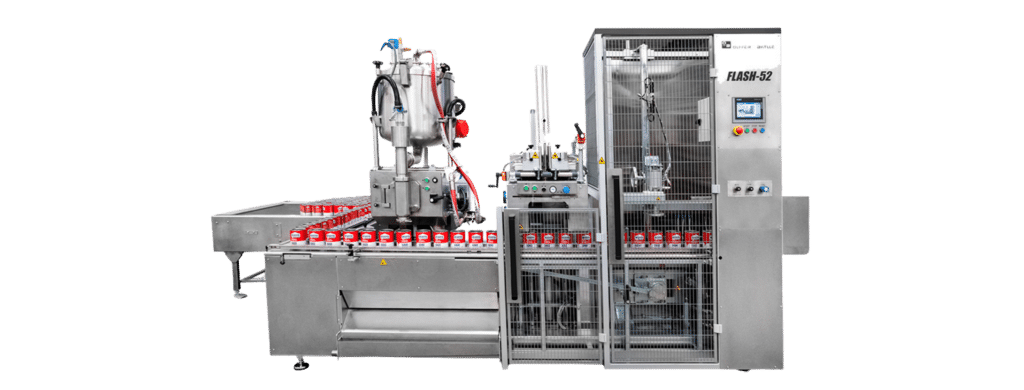
Oliver + Batlle Flash 52
What Makes Paint Hard to Fill
- Wide viscosity range. One plant may fill thin primers, emulsions, enamels and thick putties, often on the same line.
- Changing flow behaviour. Many paints are thixotropic: they thin when pumped or stirred and thicken again at rest, so the volume delivered per stroke can drift.
- Abrasion. Fillers such as calcium carbonate, talc and silica wear pumps, valves and nozzles.
- Drips and foam. Product on the rim or in the lid seat leads to poor closures and messy containers.
- Colour and product changes. Every change means cleaning hoppers, lines and nozzles, and the time this takes limits output.
- Solvents. Solvent-based products may need ATEX-rated equipment in the filling area. Our article on combustible dust and ATEX covers the hazardous area basics.
Volumetric vs Gravimetric Filling
Paint filling machines dose by volume or by weight.
A volumetric filler delivers a set volume into each container. It is fast and well suited to tins and pails of the same product. O+B’s volumetric filling machines cover semi-automatic and automatic models for containers from 0.1 to 20 litres, with one or two dosing heads and ATEX versions available. Where a product’s density or flow varies from batch to batch, a downstream checkweigher can correct the dose automatically. In one O+B decorative paint line, the checkweigher talks to both dosing heads and adjusts the volume as the paint’s rheology changes.
A gravimetric filler fills by weight, with the container sitting on a load cell. Because it measures what is actually in the container, accuracy does not depend on the product’s density or flow, which makes it the usual choice for heavy, dense or variable products and for larger containers. O+B’s gravimetric filling machines cover containers from 0.1 kg to 300 kg, from small tins to drums.
| Volumetric filling | Gravimetric filling | |
|---|---|---|
| Measures | A set volume | Net weight on a load cell |
| Best suited to | Tins and pails of consistent, free-flowing products | Dense, viscous or variable products; drums and large containers |
| O+B container range | 0.1–20 L | 0.1–300 kg |
| Accuracy | Depends on product consistency; improved with checkweigher feedback | Independent of density and viscosity changes |
| Speed | Generally faster for small containers | Slightly slower per head; dual heads close the gap |
Filling accuracy matters for compliance as well as cost. Packaged paint is sold by declared volume or weight, so every container has to meet trade measurement requirements, and every millilitre over the declared quantity is product given away.
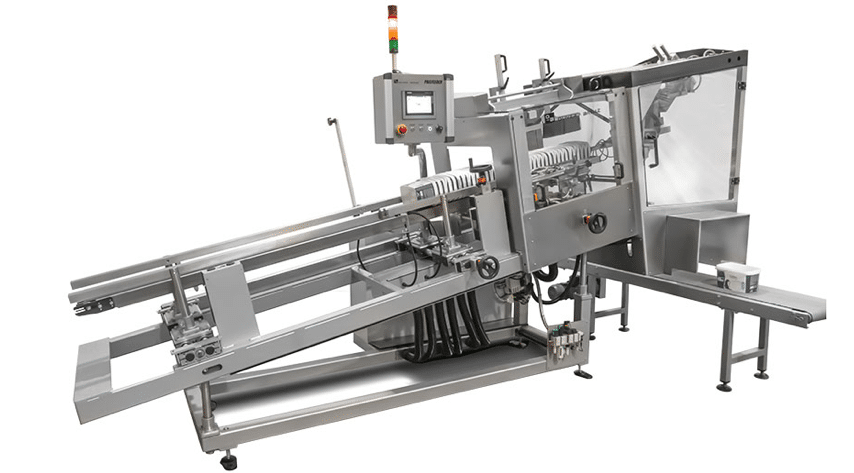
Oliver + Batlle Pail Feeder
Pail Filling Machine Options for High Viscosity Products
Putties, sealants, stucco and other products with little or no flow need a different approach to feeding the filler. O+B’s high viscosity filling units include:
- Pumped feed. Progressing cavity pumps under the product tanks feed the dosing heads directly.
- Drum and vessel discharge presses. A hydraulic press pushes product with very low or no flow out of drums or vessels.
- Volumetric dosers for doughy products. For medium and high viscosity pastes going into 1 to 5 litre containers.
In a turnkey putty line published by O+B, for a UK manufacturer of building products, a dual-head gravimetric filler fills 20 kg pails of an abrasive, high viscosity plaster at 10 containers a minute, to within ±100 g per container. All product contact parts are AISI 316 stainless steel to resist abrasion. O+B’s write-up of the project covers the full line.
Nozzle design also counts with these products. A nozzle sized to the container keeps product out of the closure area. O+B now offers custom 3D-printed filling nozzles, each designed for a specific product and container, and reports filling up to 20% faster than with conventional metal nozzles.
The Complete Paint Filling Line
A paint filling machine is usually one station in a line. O+B can supply each of these, with the equipment controlled as a single system:
- Denesting. A pail denester separates stacked empty tins and pails and places them on the conveyor. O+B denesters handle stackable metal and plastic cans from 140 to 400 mm in diameter, as well as conical, oval and rectangular pails with handles.
- Labelling. Automatic labelling before or after filling.
- Filling. Volumetric or gravimetric, with one or two dosing heads.
- Lid placing and pressing. A lid dispenser places the lid, and a press seats it.
- Checkweighing and rejection. Each container is weighed, and out-of-tolerance containers are rejected automatically.
- Palletising. Robotic palletising and pallet handling to the warehouse.
Automation is what lets one line handle many container sizes. O+B lines can change format automatically and store the settings for each product and container, from fill volume and dosing speed to conveyor speed, so changeovers do not depend on operator adjustments.
Keeping the Filler Supplied
Filling speed only helps if the process upstream can keep up. In one O+B project for a Spanish decorative paint maker, a disperser feeds two 20,000-litre tanks in turn: one batch is made while the other is being filled. Two filling lines, one for containers up to 5 litres and one for pails up to 20 litres, handle up to 29 formats between them. Because the line runs only white paint, it needs cleaning just once a week. O+B’s case study has the details.
Published O+B line speeds give a sense of scale: up to 20 containers a minute for 10-litre pails, and up to 17 a minute for 20-litre pails, on a high-speed line for stucco and wall putty.
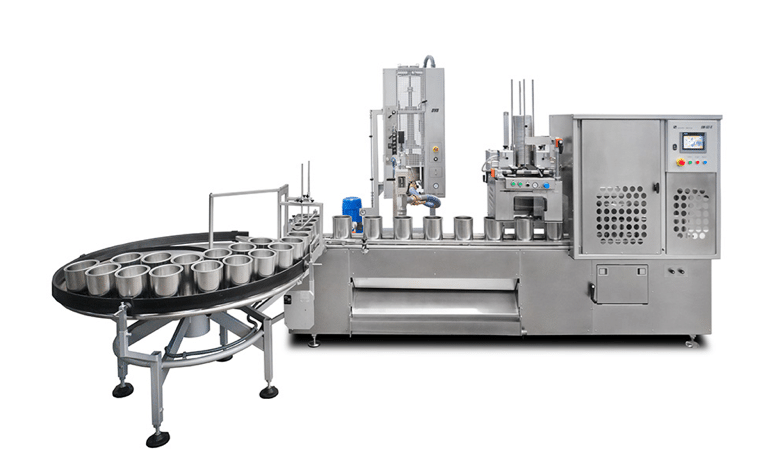
Oliver + Batlle High Viscosity Filling Unit
Questions to Answer Before Specifying a Paint Filling Machine
- Which containers will the line fill: sizes, round or rectangular, metal or plastic, and what type of lid?
- What products will it fill, and what are their viscosity and density ranges?
- Is the product water based or solvent based, and what is the hazardous area classification of the filling room?
- What fill accuracy do you need, and how much product is currently given away in overfill?
- How many containers per minute do you need, and how often do you change product, colour or container size?
- How will product reach the filler: gravity from a tank, a pump, or discharge from drums?
- How far should automation go, from manual container placement to denesting, labelling and palletising?
Paint Filling Machines in New Zealand
Advanced Packaging Systems is the exclusive New Zealand agent for Oliver + Batlle and supplies the full range of O+B industrial filling machines, from semi-automatic pail fillers to complete lines. For free-flowing liquids in bottles, our Filtec range is the better fit. Filling is the final step in the process described in our overview of paint manufacturing equipment. Contact APS to talk through your products, containers and output.
Planning a processing or packaging project?
Speak with Advanced Packaging Systems about equipment selection, line integration, and local support in New Zealand.
- Local technical and commercial support in New Zealand.
- Obligation-free advice on equipment and line fit.
- Useful next steps, even if your project is still early-stage.