

By the time milk powder leaves the spray drier it is no longer a process stream. It is finished product, and almost everything that happens to it afterwards is handling rather than transformation. The wet side of a dairy plant gets the engineering attention, but the dry side is where the specification is either protected or degraded.
For New Zealand processors, milk powders are the country’s largest dairy export by volume, and most of it goes into markets that audit the supplier as well as the product. Whole and skim milk powder, infant formula base powders and recombining blends are all sold against tight specifications for particle size, bulk density, solubility and contamination. Milk powder handling equipment is what holds those specifications between the drier and the bag.

Dinnissen Big Bag Filling Station
Why the dry side is where specification is won or lost
Once a powder is dried, its faults are difficult to correct: a liquid stream that drifts out of specification can often be diverted or reprocessed, while a dried powder that has taken on moisture or broken down its agglomerates has usually reached the end of the road for that batch. Moisture becomes a contaminant rather than a medium, so hygiene shifts from washing to keeping water out. Particle structure becomes a specified property in its own right. And contamination is harder to detect, because a dry powder gives no visual signal that anything is wrong.
Where milk powder handling equipment sits in the line
The dry side is a sequence of handling steps rather than a single machine:
- Drier discharge and fluid bed — powder is cooled and, on instantising plants, agglomerated
- Conveying — mechanical or vacuum transfer to the powder handling floor
- Screening — removal of oversize, scorched particles and agglomerate lumps
- Lump breaking and controlled milling — where caking needs reducing
- Blending — fortification with vitamins and minerals, or recombining to a target composition
- Metal and magnetic separation — contamination control ahead of packing
- Intermediate storage — silos, stainless steel IBCs or bulk bags
- Packing — bulk bag filling, bagging or canning
The decisions that matter most are usually at screening, milling and blending.

Hanningfield IBC Intermediate Bulk Container
Screening dried powder before it is packed
Screening dried milk powder does two jobs at once. It removes oversize material — agglomerate lumps, scorched particles from the drying chamber, anything introduced during transfer — and it acts as a check step giving documented assurance that the powder leaving the plant is within specification.
Milk powder is not easy to screen. It carries fat and it is hygroscopic, and both encourage mesh blinding, where particles lodge in the apertures and progressively close the screen. A screen that blinds does not fail loudly: throughput falls and efficiency drops while the machine appears to run normally, so deblinding is a specification question rather than an optional extra. Russell Finex addresses it with ultrasonic deblinding on fine-mesh dairy duties. Its Compact Sieve is the usual configuration for in-line check screening, chosen because it fits the vertical space between transfer points; where the duty is a grading separation rather than a check screen, a larger separator is the better fit.
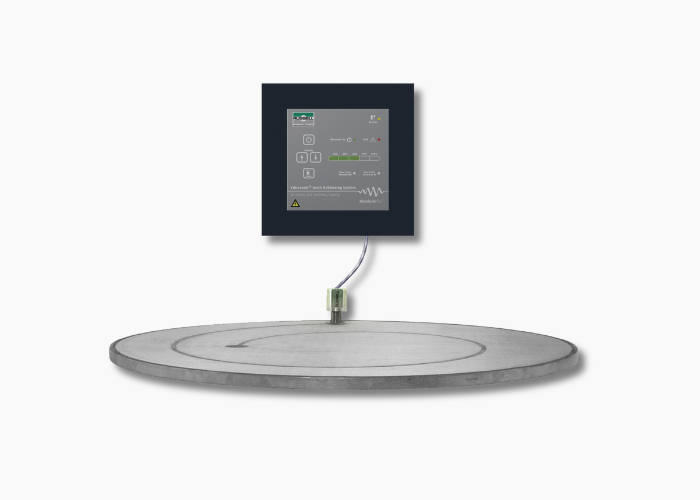
Russell Finex Ultrasonic Mesh Screener
Lump breaking and controlled milling
Milk powder cakes. Moisture pickup, compaction under its own weight in a silo and time all produce agglomerates that must be reduced before the powder can be blended or packed accurately. Conical milling suits this because it applies a gentle shearing action at controlled speed rather than impact, reducing lumps without generating a large fraction of fines. Hanningfield builds the Uni-Mill for this class of duty.
There is a balance to strike, and it is easy to get wrong. On instantised powders the agglomerate structure is the product feature — it is what makes the powder wet out and disperse quickly in water. Milling it too aggressively destroys the property the instantising step was installed to create. The target is to break unwanted caking while leaving engineered agglomerates intact, which is a matter of screen selection, impeller design and tip speed rather than simply running the mill slower.

Hanningfield Uni Mill – ATEX Certified
Blending fortified and recombined powders
Fortification and recombining both mix components that differ in particle size, density and quantity, which is the duty the Dinnissen Pegasus mixer is built for. Vitamin and mineral premixes are added at fractions of a percent and must be distributed uniformly through a batch of several tonnes. The measure that matters is the coefficient of variation across the batch, and the risk that undermines it is segregation — the tendency of a well-mixed powder to separate again during discharge, transfer and filling — which makes the arrangements downstream of the blender part of the same conversation as the blender itself.
Contamination, dust and dry-side hygiene
Metal contamination control is layered rather than singular. Magnetic separation removes ferrous material carried in with ingredients or generated by wear upstream, positioned to protect downstream equipment as well as the product, while metal detection at packing provides the final verified check. New Zealand processors operate under a risk management programme registered under the Animal Products Act 1999, with further requirements set by the destination market and infant formula at the strictest end of that range, so the control steps have to be documented and repeatable rather than simply present.
Milk powder is also a combustible dust, so any step that generates an airborne cloud in a confined space — discharge points, transfer chutes, bag filling — is where dust control and hazardous area assessment apply. Dry-side hygiene inverts the usual assumption: where the wet side is cleaned in place with water and chemicals, the powder side is cleaned dry wherever possible, because introducing water is what creates caking and residue. Equipment is chosen for how completely it can be dismantled and dry-cleaned, and contained transfer using Hanningfield stainless steel IBCs reduces the number of open handling steps altogether, as does enclosed bulk bag filling.

Russell Finex Magnetic Separator
Specifying milk powder handling equipment
Most specification difficulties come from settling the wrong questions first. The ones worth establishing early:
| Consideration | What to establish |
|---|---|
| Powder type and specification | Whole, skim, instantised or fortified; the particle size and bulk density the product is sold against |
| Agglomerate structure | Whether agglomeration is an engineered feature milling must preserve, or unwanted caking to remove |
| Screening duty | Check screening for assurance, or grading to a size cut — the two size differently |
| Blinding risk | Mesh size, fat content and ambient humidity, and whether a deblinding system is required |
| Throughput and headroom | Tonnes per hour at the screening point, and the vertical space between transfer points |
| Contamination control points | Where magnetic separation sits relative to metal detection, and what each protects |
Local supply and support in New Zealand
Powder handling equipment is rarely bought as a single machine: a screening upgrade has implications for the transfer arrangement above and below it. Advanced Packaging Systems supplies the Russell Finex screening and separation range, Hanningfield milling and contained transfer equipment, and Dinnissen blending and bulk bag handling from a single point of contact, with local commissioning, spares and servicing support.
Planning a processing or packaging project?
Speak with Advanced Packaging Systems about equipment selection, line integration, and local support in New Zealand.
- Local technical and commercial support in New Zealand.
- Obligation-free advice on equipment and line fit.
- Useful next steps, even if your project is still early-stage.
Frequently asked questions
What is milk powder handling equipment?
The equipment used to move, screen, mill, blend, store and pack milk powder after it leaves the spray drier — conveying and transfer, sieves and separators, lump breakers and conical mills, blenders, magnetic separators, IBCs and bulk bag systems, and packing equipment.
Why does milk powder blind screens?
Milk powder carries fat and readily absorbs moisture from the air. Both encourage particles to lodge in the screen apertures and stay there, progressively closing the mesh. Throughput falls and separation efficiency drops without the machine appearing to fail, which is why fine-mesh dairy duties often specify deblinding.
Does milling milk powder damage the product?
It can. On instantised powders the agglomerate structure gives the product its wetting and dispersion characteristics, so milling that reduces those agglomerates removes a specified feature. The aim is to break unwanted caking while leaving engineered agglomerates intact.