
Almost every powder process includes a screening step. Sifting removes oversize contamination, breaks down agglomerates, grades product into particle-size fractions and provides a final safety or check screen before packing — protecting product quality and, for exporters, meeting customer and regulatory standards. The question is rarely whether to screen, but which screening technology fits the product and the line.
New Zealand processors generally choose between four established dry-screening methods, all supplied by Advanced Packaging Systems through its partners. Dinnissen contributes two — the centrifugal sifter for powders and the rotary drum sifter for grains, pellets and chunks — while Russell Finex supplies the vibratory and ultrasonic screeners. This article explains how each works and where it fits, starting with the centrifugal sifter.

Dinnissen Centrifugal Sifter
What an industrial sifter does in a powder process
Whatever the technology, an industrial sifter earns its place by doing one or more of four jobs:
- Safety (check) screening — a final guard before packing, removing foreign matter and oversize before the product reaches the customer.
- Contamination control — separating string, lumps, packaging fragments and other foreign bodies introduced upstream during milling, blending or conveying.
- De-agglomeration — breaking down soft lumps so the finished powder flows and doses consistently.
- Grading — separating a feed into two or more particle-size fractions for different uses or specifications.
Dinnissen Rotary Drum Sifter
Centrifugal sifters: the Dinnissen approach
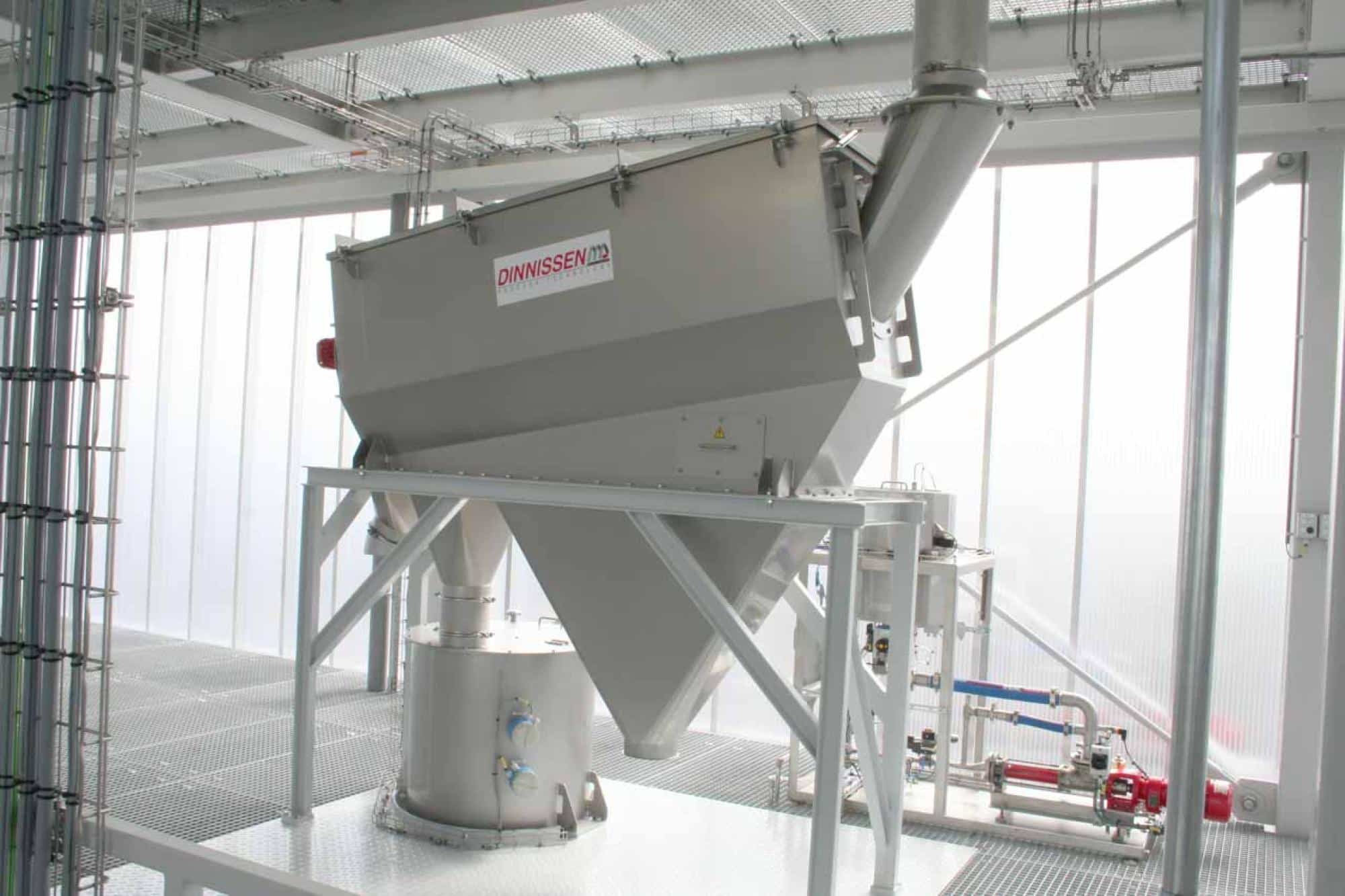
A Dinnissen Centrifugal Sifter sifts large quantities of product quickly and accurately. Inside the machine, a cylindrical sieve drum rotates on its axis. Product enters by gravity or pneumatic conveying, and the rotating motion uses centrifugal force to press it against the perforated drum wall. Particles small enough pass through the holes; oversize material and contaminants stay in the chamber and are led to a separate outlet, where the residue is easily removed.
That principle makes the centrifugal sifter the high-throughput option of the four. A single machine handles anything from a few kilograms per hour to more than 39 tonnes per hour, with mesh openings between 250 and 2000 µm — and finer than 75 µm where a nylon-fabric screen or Dinnissen’s ultrasonic assistance is used. Because it can be fed pneumatically and runs enclosed, it suits in-line safety screening and de-lumping in modern automated lines rather than batch, open-deck duties. Dinnissen has installed more than 500 centrifugal sifters to date.
| Dinnissen Centrifugal Sifter | Specification at a glance |
|---|---|
| Operating principle | Rotating cylindrical sieve drum; centrifugal force presses product through a perforated screen wall. |
| Throughput | From a few kilograms per hour to more than 39 tonnes per hour, depending on product and screen. |
| Mesh openings | 250–2000 µm standard; fine products below 75 µm achievable with nylon fabric or ultrasonic assistance. |
| Screen material | Nylon fabric or stainless steel, matched to the product and hygiene requirement. |
| Hazardous areas | Available with ATEX Zone 20 approval; PED inspection and Notified Body certificate for pneumatic systems above 0.5 bar overpressure. |
| Integration | Fed by gravity or pneumatic conveying; integratable into existing lines. Over 500 units installed worldwide. |
For food and feed duties the sifter is built to strict hygiene and safety standards, and it can be supplied with ATEX Zone 20 approval for explosive dusts. Where the sifter sits within a pneumatic system above 0.5 bar overpressure, Dinnissen provides a Pressure Equipment Directive (PED) inspection and supplies the machine with an approved Notified Body certificate. The same combustible-dust principles covered in our guide to combustible dust, ATEX and hazardous-area equipment apply directly here.

Rotary Drum Sifter
Rotary drum sifters: gentle screening for grains, pellets and chunks
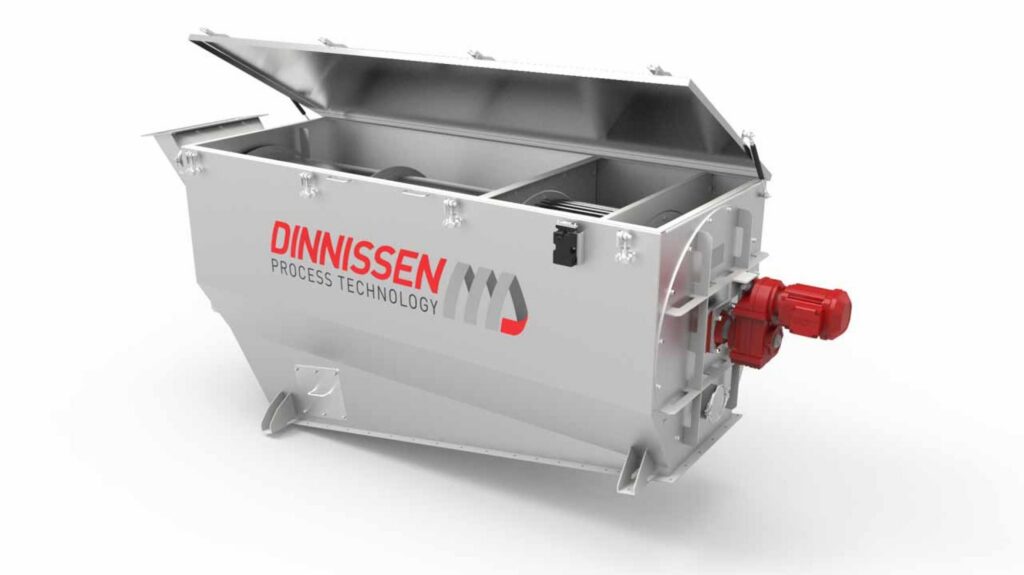
Where the centrifugal sifter is built for powders, Dinnissen’s Rotary Drum Sifter is the right tool for grains, pellets and chunks. It is an inclined, slowly rotating drum: product enters at the top and tumbles gradually downward under gravity, and only particles small enough pass through the perforated wall, while oversize is retained and discharged through a separate outlet. The key difference is speed — the drum turns at less than one metre per second, which keeps the separation gentle and non-destructive, so fragile pellets and granules are not damaged and both the fine and coarse fractions can be reused.
Because the drum can carry different perforation sizes along its length, a single machine can grade a feed into two or three fractions — separating grit and fines at the top, collecting on-spec product in the middle, and returning oversize chunks to the process. Extra-large variants are used purely to scalp impurities from incoming raw materials. The sifter handles dried granules and chunks as well as moister, sticky mixtures, runs in accordance with ATEX guidelines, and is especially suited to pet food and feed production — both significant New Zealand sectors.
Russell Finex Ultrasonic Mesh Screener
Vibratory screeners: versatile check-screening and grading
Where the centrifugal sifter excels at high-throughput in-line screening, a circular vibratory screener is the versatile workhorse for check-screening and grading. A vibratory motion moves product across a horizontal mesh deck, separating it by particle size; stacking decks allows grading into several fractions at once. The Russell Compact Sieve® is the compact, half-height expression of this principle, screening to around 20 µm with tool-free assembly. It is the natural choice where footprint, fast screen changes and flexible grading matter more than raw tonnage.
Ultrasonic screeners: for fine powders that blind the mesh
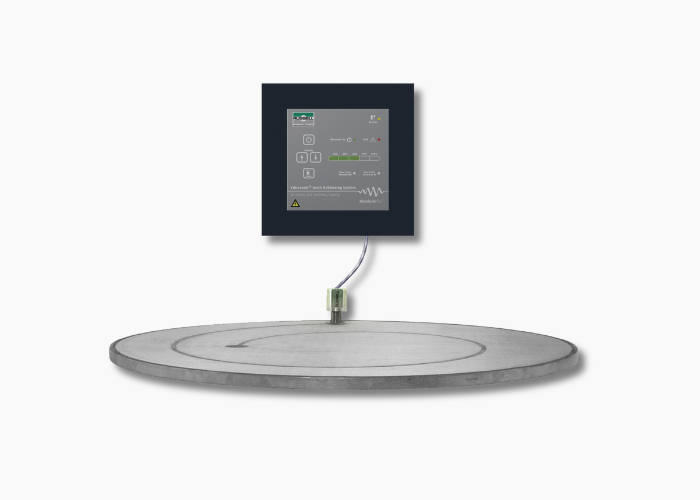
The finer the powder, the more readily it blinds a screen — near-aperture particles lodge in the mesh, throughput collapses and accuracy drifts. The Russell Finex Vibrasonic® deblinding system answers this by applying an ultrasonic frequency to the fine mesh, keeping it clear so very fine or cohesive powders can be screened reliably. It is an enhancement to vibratory screening rather than a separate machine class, and it is the right answer for sub-100 µm dairy powders, metal powders and similar difficult materials. Notably, Dinnissen also offers ultrasonic assistance on its centrifugal sifters for the same reason.
Planning a processing or packaging project?
Speak with Advanced Packaging Systems about equipment selection, line integration, and local support in New Zealand.
- Local technical and commercial support in New Zealand.
- Obligation-free advice on equipment and line fit.
- Useful next steps, even if your project is still early-stage.
How to choose
The technologies overlap, but each has a centre of gravity. As a rule of thumb: choose a centrifugal sifter for high-throughput, in-line and pneumatic safety screening and de-lumping of powders; a rotary drum sifter for gentle grading and scalping of grains, pellets and chunks where product integrity matters; a vibratory screener for flexible check-screening and grading in a compact footprint; and an ultrasonic screener where the powder is fine enough to blind a conventional mesh.
| Technology | How it separates | Best suited to | Indicative throughput |
|---|---|---|---|
| Centrifugal sifter (Dinnissen) | A rotating cylindrical drum uses centrifugal force to press product through a perforated screen; oversize and contaminants exit separately. | High-capacity safety screening and de-lumping of powders, especially in-line and in pneumatic conveying systems. | A few kg/hr to more than 39 t/hr |
| Rotary drum sifter (Dinnissen) | An inclined, slowly rotating drum moves product by gravity; undersize falls through the perforated wall while oversize is retained. | Gentle, non-destructive grading and scalping of grains, pellets and chunks — ideal for pet food and feed. | By construction size; low-speed duty |
| Vibratory screener (Russell Finex) | A circular vibratory motion moves product across a horizontal mesh deck, separating it by particle size. | Versatile check-screening and grading into one or more fractions, with a compact footprint. | Low to high, by model and mesh |
| Ultrasonic screener (Russell Finex Vibrasonic®) | An ultrasonic frequency is applied to fine mesh to keep it clear (deblinding), added on top of vibratory screening. | Very fine or cohesive powders that would blind a standard mesh — e.g. fine dairy or metal powders. | Low to moderate, fine-mesh duties |
Hygiene, ATEX and New Zealand compliance
All four technologies are available in hygienic, stainless-steel designs suited to dairy, pharmaceutical and nutraceutical and food production, with easy cleaning and minimal product residue. For dusty powders, ATEX-rated versions allow safe operation in classified zones — an increasingly common requirement in New Zealand powder plants. Dinnissen’s organisation is certified to ISO 9001, 14001, 27001 and 45001.
Part of a complete processing line
Screening rarely sits in isolation. A centrifugal sifter is frequently paired with powder blending, milling, pneumatic conveying and bulk bag handling in one integrated line. As the exclusive New Zealand agent for Dinnissen and the local partner for Russell Finex, Advanced Packaging Systems can specify the right screening technology for the duty and integrate it into the wider process. For the full sieving and screening range, see our vibratory sieves and screeners overview.
Frequently asked questions
What is a centrifugal sifter?
A centrifugal sifter is a screening machine with a rotating cylindrical drum. Centrifugal force presses product against a perforated screen so that undersize passes through and oversize or contaminants are discharged separately. It is well suited to high-throughput, in-line and pneumatic safety screening — Dinnissen’s sifters handle from a few kilograms per hour to more than 39 tonnes per hour.
What is the difference between a centrifugal sifter and a vibratory screener?
A centrifugal sifter uses a rotating drum and centrifugal force, favouring high throughput and enclosed, in-line operation. A vibratory screener moves product across a horizontal mesh deck by vibration, favouring flexible check-screening and grading into multiple fractions in a compact footprint.
When should I use a rotary drum sifter instead of a centrifugal sifter?
Use a rotary drum sifter when the product is granular or fragile — grains, pellets or chunks — rather than a fine powder. Its slow, inclined drum (under one metre per second) grades and scalps gently and non-destructively, which protects pellet integrity. The centrifugal sifter, by contrast, is the high-throughput choice for powders.
Which sifter is best for very fine or cohesive powders?
Fine powders tend to blind a standard mesh. An ultrasonic screener — such as the Russell Finex Vibrasonic® — applies an ultrasonic frequency to keep the mesh clear, allowing reliable screening of sub-100 µm and cohesive powders. Ultrasonic assistance is also available on Dinnissen centrifugal sifters.
Are industrial sifters available for explosive (ATEX) environments?
Yes. Dinnissen centrifugal sifters can be supplied with ATEX Zone 20 approval, with a PED inspection and Notified Body certificate where they form part of a pressurised pneumatic system. Russell Finex screeners are likewise available in ATEX-rated configurations.
Planning a processing or packaging project?
Speak with Advanced Packaging Systems about equipment selection, line integration, and local support in New Zealand.
- Local technical and commercial support in New Zealand.
- Obligation-free advice on equipment and line fit.
- Useful next steps, even if your project is still early-stage.