
Nutraceutical powder blending and milling processes typically involves three linked operations: blending (bringing ingredients into a homogeneous mix), milling or particle size reduction (ensuring a consistent particle size for dissolution and bioavailability), and screening (verifying product purity and removing oversized particles or contaminants before packaging). Each step affects the next. Getting all three right requires equipment designed specifically for the task.
The Real Challenges in Nutraceutical Powder Processing
Powder blending looks straightforward from the outside. In practice, it is one of the more technically demanding operations in nutraceutical manufacturing, for three reasons:
Segregation. Powders with different particle sizes and densities naturally separate during movement. A vitamin premix blended in one vessel and then transferred to another will partially unmix during the transfer, defeating the blending step. Equipment design , including gentle handling, minimal transfer distances, closed systems, is the primary solution.
Ingredient sensitivity. Probiotics, heat-sensitive vitamins, and encapsulated actives can be damaged by excessive mechanical stress, heat from friction, or exposure to moisture during processing. The blending process must achieve homogeneity without creating these stresses.
Regulatory documentation. GMP requirements for nutraceuticals sold into pharmaceutical-adjacent markets demand batch records, equipment validation, and cleaning validation. Equipment needs to support these requirements, not create additional documentation burden.
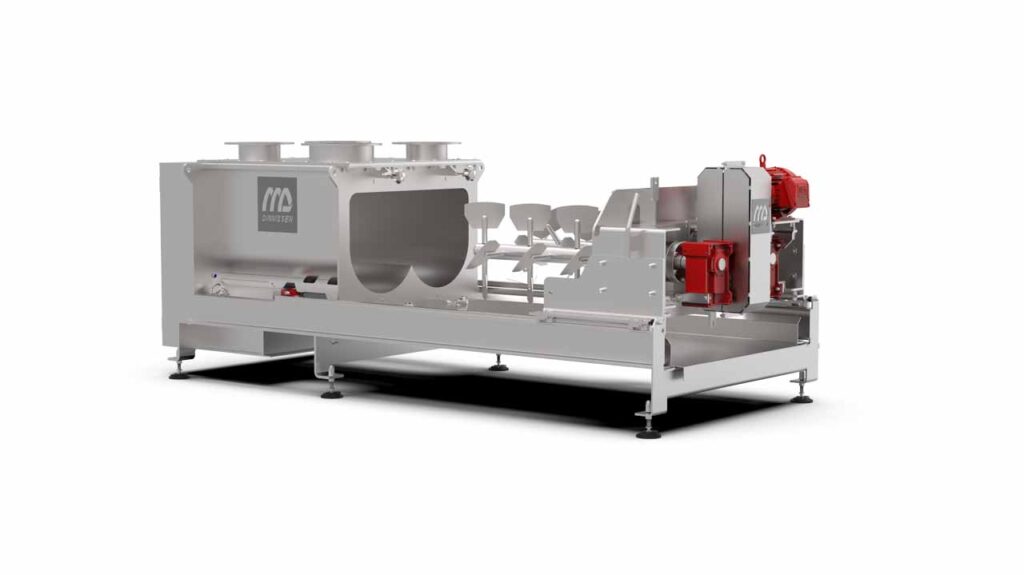
Pegasus Hygienic Batch Mixer
Gentle, Uniform Blending: The Dinnissen Pegasus® Mixer
The Dinnissen Pegasus® mixer uses a horizontal paddle and screw configuration designed to achieve homogeneous blending with minimal product degradation. The mixing action is deliberately gentle — paddles move the product mass in a slow, consistent pattern that brings all ingredients into contact without the aggressive mechanical shear that damages fragile particles or heat-sensitive compounds.
For nutraceutical applications, this gentleness is often the deciding factor. Encapsulated probiotics, spray-dried vitamin complexes, and protein powders processed through high-intensity blenders can show measurable losses in biological activity. The Pegasus® maintains ingredient integrity while still achieving excellent blend uniformity within typical batch times of 3 to 15 minutes, depending on formulation and fill level.
The Pegasus® range covers batch sizes from pilot scale through to multi-tonne industrial production. The design supports GMP documentation requirements with full cleanability, CIP compatibility, and ATEX-compliant variants for products with dust explosion risk — a relevant consideration for many organic nutraceutical powders.
Particle Size Control: The Hanningfield Uni-Mill
A well-blended product with inconsistent particle size distribution will produce inconsistent results downstream — whether that is uneven tablet compression, variable dissolution rates in a drink mix, or poor mouthfeel in a chewable supplement. Particle size uniformity is a critical quality attribute, and the Hanningfield Uni-Mill cone mill is designed specifically to achieve it.
The Uni-Mill uses a rotating impeller within a conical screen to reduce particle size through a combination of impact, compression, and attrition. Unlike hammer mills, which apply high-impact energy that can overheat or damage heat-sensitive ingredients, the Uni-Mill’s action is controlled and relatively gentle — well suited to pharmaceutical and nutraceutical powder milling.
Interchangeable screen inserts allow operators to select the particle size output appropriate to the formulation, and screen changes are made quickly during production to accommodate different products. The Uni-Mill’s design fully supports GMP requirements: product contact parts are removable for cleaning or autoclaving, all surfaces are electropolished stainless steel, and ATEX-compliant variants are available. For highly potent ingredients or compounds requiring containment, Hanningfield also offers integrated containment milling solutions.

Hanningfield Uni Mill
Ensuring Product Purity: Russell Finex Vibratory Screeners
The final step before packaging — and an important quality checkpoint at earlier stages — is screening. Vibratory screeners check the product for oversized particles, agglomerates, and foreign material, and divert material outside the target particle size range before it reaches the next process stage.
Russell Finex vibratory screeners are widely used in nutraceutical powder applications. Standard vibratory screening handles the majority of free-flowing powders effectively. For cohesive or sticky powders — certain protein blends, fine herbal extracts, hygroscopic vitamin powders — the Vibrasonic® ultrasonic sieve applies ultrasonic energy to the screen mesh, preventing blinding and maintaining consistent throughput even in difficult materials.
The addition of an ultrasonic system can transform a screening step that previously required constant operator attention into a reliable, largely unattended process stage. For nutraceutical operations running multiple product types through the same equipment, this reliability is worth the additional investment. Russell Finex equipment complies with EHEDG hygienic design principles and FDA food-contact material requirements.
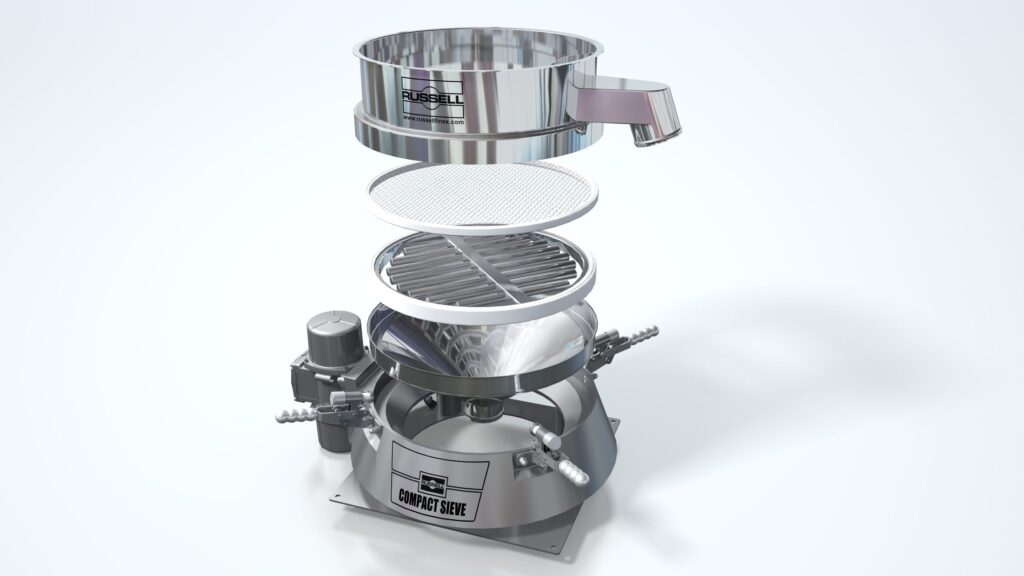
Russell Finex Compact Sieve
The Full Powder Processing Workflow
The three operations — blending, milling, and screening — are most effective when specified as a system. The output particle size distribution from the Pegasus® blender should inform the input specification for the Uni-Mill; the Uni-Mill’s screen selection then determines the particle size range that the Russell Finex screener needs to handle downstream.
Advanced Packaging Systems represents Dinnissen, Hanningfield, and Russell Finex in New Zealand, making it possible to specify the full powder processing workflow from a single local source. This matters not just for convenience at the specification stage but for ongoing support: one point of contact for technical queries, spare parts, and service across the complete system.
Planning a processing or packaging project?
Speak with Advanced Packaging Systems about equipment selection, line integration, and local support in New Zealand.
- Local technical and commercial support in New Zealand.
- Obligation-free advice on equipment and line fit.
- Useful next steps, even if your project is still early-stage.
Powder Processing Equipment for New Zealand Nutraceutical Manufacturers
Whether you are establishing a new nutraceutical powder line, upgrading an existing facility, or troubleshooting a consistency issue in your current process, Advanced Packaging Systems can advise on equipment selection, line layout, and GMP documentation requirements.
Contact the APS team to discuss your powder processing requirements.