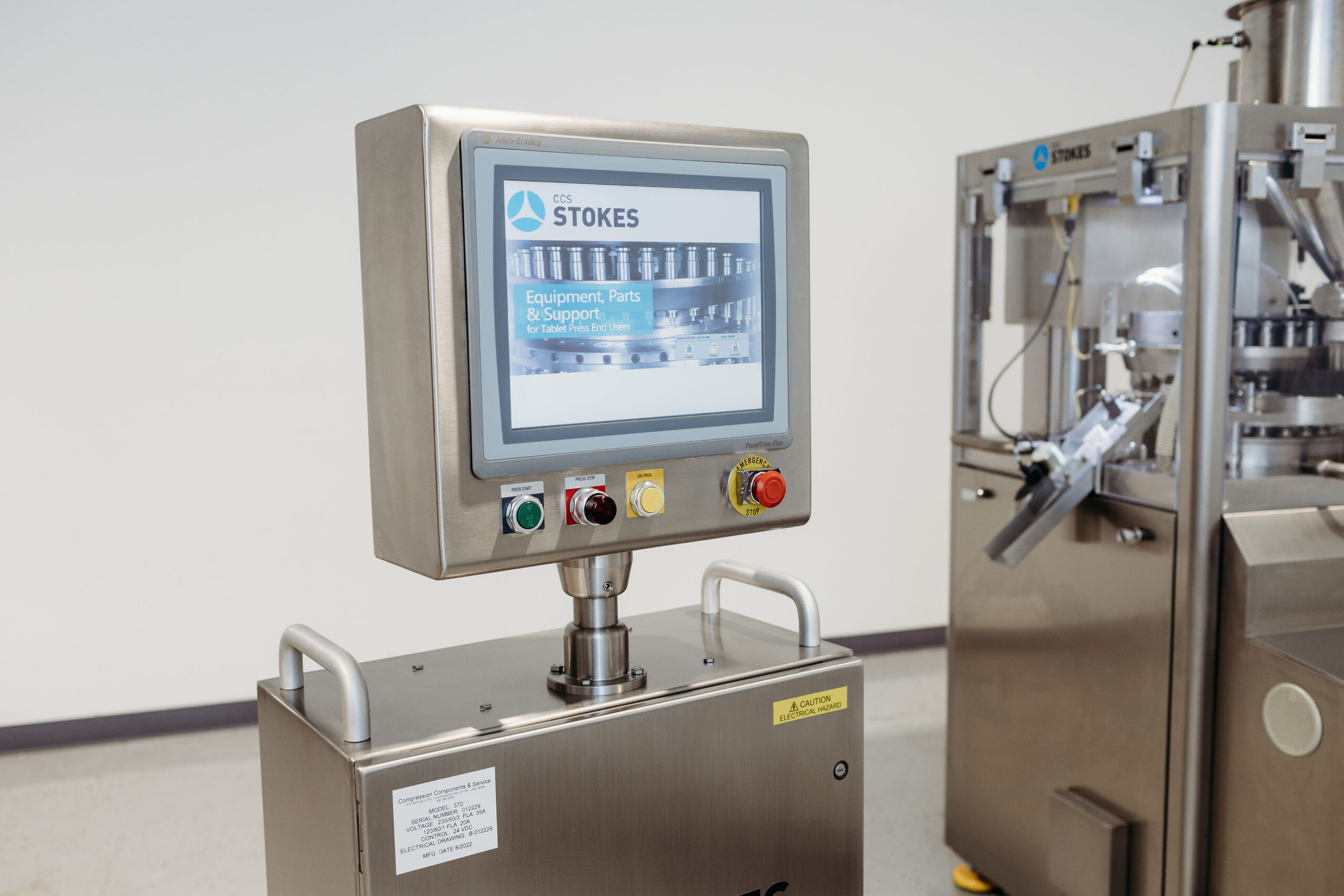
For a New Zealand manufacturer producing tablets at commercial volume, the rotary tablet press is the default choice. Advanced Packaging Systems is the exclusive New Zealand agent for Stokes, a US manufacturer that has built tablet presses since 1895, with sales and technical support provided from APS’s Auckland base. This article focuses on the high-speed rotary range that suits the bulk of production tableting, and notes where single-station presses still earn their place.
Why Rotary Presses Are the Production Standard
A single-station press has one set of tooling and produces one tablet per compression cycle. That makes it well suited to research and development and to short runs, but its output is limited by design. A rotary press carries multiple tooling stations on a rotating turret. As the turret turns, each station is filled, pre-compressed, compressed and ejected in sequence, so the machine produces tablets continuously rather than one at a time. Output scales with the number of stations and the turret speed.
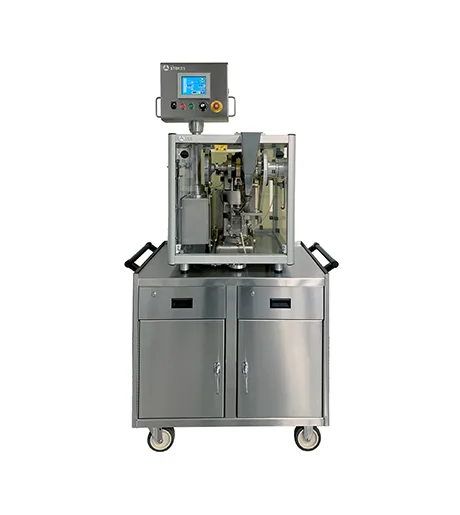
Stokes Model 511 Tablet Press
Rotary presses also compress in two stages. A pre-compression roller removes entrapped air from the powder before the main compression roller forms the tablet. This deaeration step improves tablet integrity, reduces capping and lamination, and supports consistent hardness and weight across long production runs — exactly the kind of repeatability that GMP-regulated pharmaceutical and nutraceutical manufacturing depends on. For New Zealand producers running commercial batches of solid-dose pharmaceuticals or supplements, rotary is the natural fit.
The Stokes High-Speed Rotary Range
Stokes’s production rotary presses span single-sided machines for high-speed output through to double-sided machines built for maximum throughput. All are manufactured in the USA and configured for pharmaceutical and nutraceutical production.
| Model | Configuration | Stations | Max output (tablets/hr) | Compression | Max Ø |
|---|---|---|---|---|---|
| 370 | Single-sided, high-speed | 26–40 | up to ~264,000 | 100 kN | 25 mm |
| 560 | Single-sided, bi-layer capable | 41–61 | up to ~292,800 | 100 kN | 25 mm |
| 720 | Double-sided (flagship output) | 51–83 | up to ~796,800 | 80 kN | 25 mm |
| 328 | High-speed, large tablets | 33–45 | up to ~270,000 | 100 kN | 30 mm |
The Model 370 is a single-sided, high-speed press available in 26, 32 or 40 stations, delivering up to roughly 264,000 tablets per hour at 100 kN of compression force. The Model 560 steps up to 41–61 stations and around 292,800 tablets per hour, adds two pre-compression stations, converts to bi-layer production, and uses a removable turret that simplifies cleaning and changeover. The double-sided Model 720 is the flagship for output: in its 83-station configuration it produces up to approximately 796,800 tablets per hour — close to 800,000 — with pre-compression, a bi-layer option and a detachable turret.
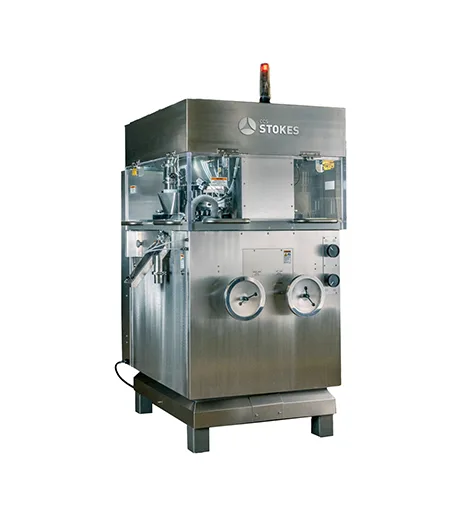
Stokes Model 328 Tablet Press
Where larger tablets or compacts are required, the Model 328 runs at high speed up to around 270,000 tablets per hour at 100 kN and handles diameters up to 30 mm, while the closely related Model 334 raises compression force to 150 kN for tougher or larger formats.
Heavy-Tonnage and Industrial Compaction
Beyond standard solid-dose work, Stokes builds heavy-tonnage rotary presses for large tablets and industrial compacts. The Models 516 and 557 compress up to 199 kN with deep-fill capability and tablet diameters from 30 mm to 90 mm, the 516 in a double-sided configuration and the 557 as a single-sided high-volume press. The Model 349 reaches 294 kN — roughly 30 tonnes — for large compacts up to 76 mm in diameter, suiting applications such as chlorine tablets, catalysts and ceramics. The 550 series provides dependable 12-ton, single-sided presses for pharmaceutical, powder-metal and ceramic work, forming tablets up to 30 mm in diameter.
This breadth means a single supplier can cover the full spectrum from high-speed pharmaceutical tableting to non-pharmaceutical industrial compaction.
Planning a processing or packaging project?
Speak with Advanced Packaging Systems about equipment selection, line integration, and local support in New Zealand.
- Local technical and commercial support in New Zealand.
- Obligation-free advice on equipment and line fit.
- Useful next steps, even if your project is still early-stage.
Where Single-Station Presses Still Fit
High-speed rotary is the right answer for most production scenarios, but the single-station press has not been displaced. It remains the sensible tool for formulation development, very small batches, and operations where capital budget is the binding constraint. A single-station press allows compression force, dwell time and punch penetration depth to be adjusted independently, which is valuable during product development, and it represents a lower-cost entry point into tablet manufacturing. For a manufacturer not yet running continuous production volumes, or one developing and validating new formulations, a single-station Stokes press is often the appropriate starting point — with a clear upgrade path to rotary as volumes grow.
Features That Matter in Multi-Product Facilities
Several rotary features carry particular weight in regulated, multi-product plants:
- Pre-compression — improves deaeration and reduces capping and lamination, especially on difficult formulations.
- Bi-layer capability — supports combination products and modified-release formats without a separate machine.
- Removable or detachable turrets — speed up cleaning and product changeover and support cross-contamination control between products.
- Control systems — provide in-process compression-force monitoring and the records needed for GMP documentation.
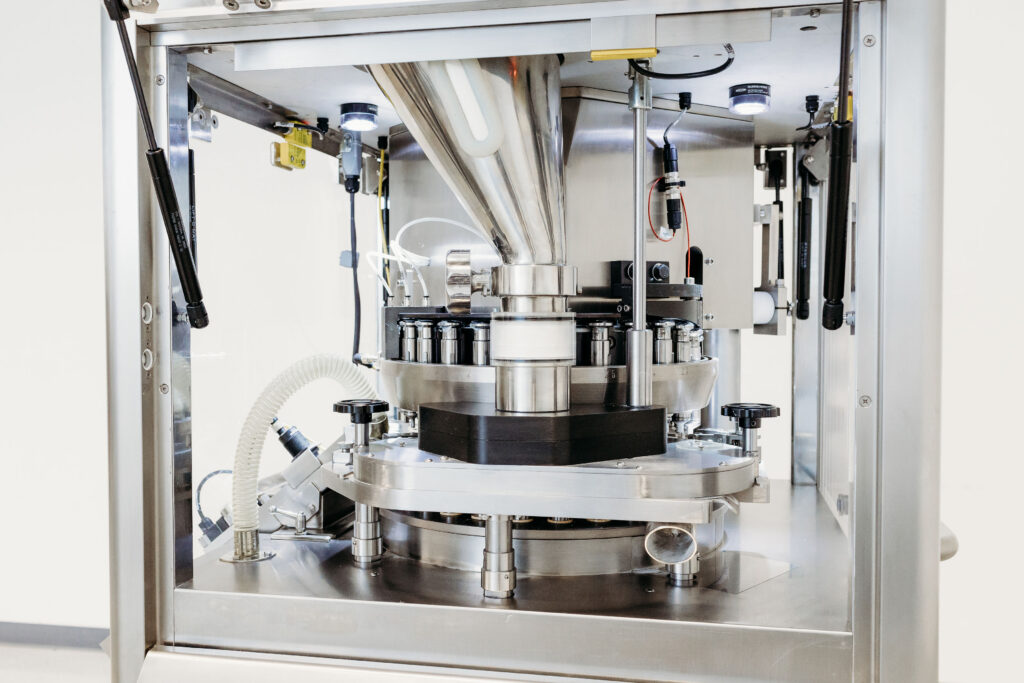
Stokes Model 370
Tooling, Parts and Long-Term Support
A tablet press is a long-term capital asset, and APS supplies the tooling and parts that keep it productive alongside the press itself. Elizabeth compression tooling — TSM and EU configuration punches and dies, including multi-tip tooling for higher output per revolution — can be matched to a new Stokes press and its tablet geometry. Scheu & Kniss replacement parts and turrets, including segmented turret designs, support Stokes and most other major press platforms over the long term. For New Zealand manufacturers, sourcing the press, its tooling and its spare parts through APS removes the lead-time and freight complexity of dealing with multiple overseas vendors.
Local Supply and Support
As the exclusive New Zealand agent for Stokes, Advanced Packaging Systems provides sales and technical support and distribution from its Auckland store. For case studies, detailed technical specifications, or advice on selecting between rotary configurations, please get in touch with the APS team.