
New Zealand has a small but fast-developing precision fermentation and biotechnology sector, driven largely by its dairy heritage and the search for complementary, lower-emission ways to produce proteins and other ingredients. As local companies move from laboratory proof-of-concept toward pilot and commercial production, the question of where to source fermentation equipment including, suitable bioreactors, fermenters and bioprocessing equipment becomes top of mind.
Advanced Packaging Systems can provide local advice and assistance to New Zealand manufacturers exploring this area, and supports enquiries for systems from KBiotech, a Swiss manufacturer of modular bioreactors and fermenters.
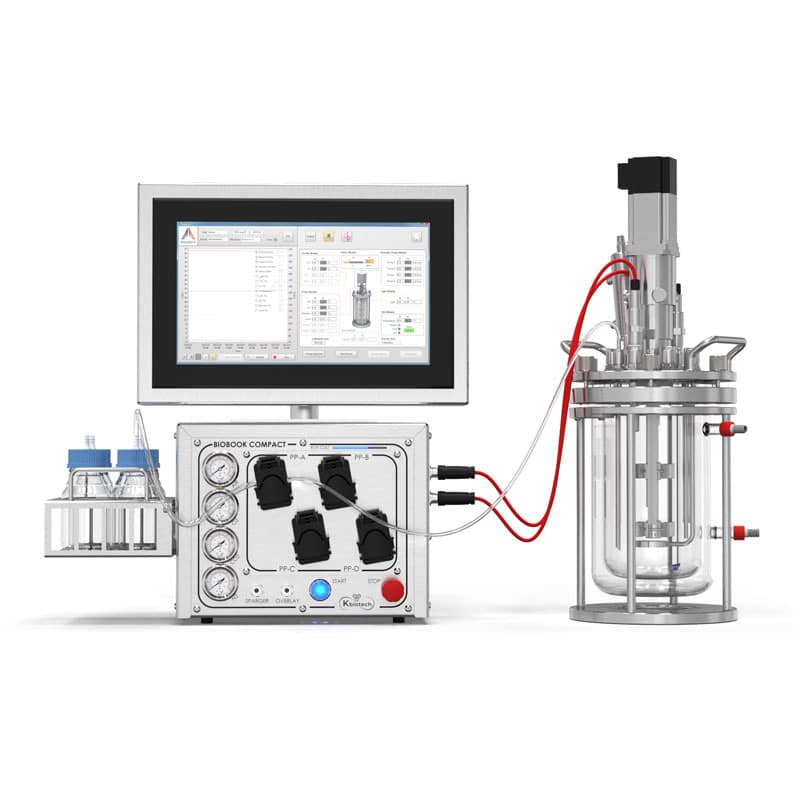
BioBook Compact Bioreactor
New Zealand’s Emerging Precision Fermentation Sector
Precision fermentation uses engineered micro-organisms to produce specific ingredients, proteins, fats, enzymes, by fermentation rather than from animals or plants. For a country whose economy is built on dairy, it represents both a competitive challenge and an opportunity, and New Zealand research bodies, startups and incumbents are all now active in the space.
Auckland-based Daisy Lab is producing animal-free whey protein by precision fermentation; it has raised seed funding with support from Icehouse Ventures and Outset Ventures among others, received backing through Callaghan Innovation and the Westpac NZ Government Innovation Fund, and gained Environmental Protection Authority approval to scale up. Eden Brew, operating across Australia and New Zealand, is developing animal-free dairy proteins and has progressed a novel-food application with Food Standards Australia New Zealand (FSANZ) — which has accepted its first application for a precision-fermented milk protein, an important signal that a regulatory pathway exists.
Crown research institute AgResearch runs a precision fermentation programme, and the established dairy sector is engaging through its own ventures. The common thread is a pipeline of organisations that will, over time, need fermentation and downstream processing equipment at increasing scale.

Industrial SIP Bioreactors
KBiotech: Modular Bioreactors and Fermenters
KBiotech designs and manufactures modular bioprocessing systems that scale from laboratory R&D through pilot development to industrial manufacturing. Headquartered in Switzerland with production in Italy and part of the Vinci Life Science Applied SA group, the company has served the life-sciences industry for more than 40 years, holds ISO 9001 certification, and reports installations in more than 30 countries across biopharma, food technology, industrial biotechnology and clean energy.
The product line spans the full scale range:
| System | Working volume | Typical use |
|---|---|---|
| Benchtop bioreactors | 50 ml – 20 L | R&D and academic labs; single, twin or parallel set-ups |
| Single-use bioreactors | 500 ml – 10 L | Sterile, disposable upstream bioprocessing |
| In-situ sterilisable bioreactors & fermenters | 3 L – 20,000 L | Pilot and industrial production; CIP/SIP-ready |
| CIP/SIP skids | 1 L – 5,000 L | Automated clean-in-place and steam-in-place |
| Biogas & bioenergy reactors | 1 L – 20,000 L | Anaerobic digestion and bioenergy |
| Media preparation & buffer tanks | 3 L – 20,000 L | Media/buffer prep; 316L/304L/904L alloys |
Tying the range together is Smart-BioFlex™, KBiotech’s SCADA and HMI automation platform, which is designed to control and monitor bioprocesses consistently from R&D-scale units up to 20,000 L GMP production systems. Modular control units are available with Siemens, Rockwell and Emerson PLC compatibility, allowing integration into a manufacturer’s existing automation ecosystem. This combination of a single control platform with cross-compatible hardware is what allows a producer to develop a process on a benchtop unit and carry the same control approach through to industrial scale.
Planning a processing or packaging project?
Speak with Advanced Packaging Systems about equipment selection, line integration, and local support in New Zealand.
- Local technical and commercial support in New Zealand.
- Obligation-free advice on equipment and line fit.
- Useful next steps, even if your project is still early-stage.
Scaling from R&D to Production
For New Zealand’s precision fermentation companies — most of which are early in their commercial journey — the practical challenge is the transition from a working laboratory process to validated production. A modular platform supports that progression: a benchtop or single-use system for strain and process development, in-situ sterilisable fermenters for pilot runs, and full industrial vessels with integrated CIP/SIP for manufacturing, all under one control system. Media preparation and buffer tanks and, where relevant, biogas and bioenergy reactors round out the process. Approaching scale-up this way reduces the technical risk of moving between stages and shortens the path from development to market.

Industrial SIP Bioreactors
Applications Beyond Food Technology
While precision fermentation for alternative proteins is the most visible application in New Zealand, the same equipment categories serve a wider set of sectors: biopharmaceutical production (including cell and gene therapy, antibodies and vaccines), industrial biotechnology (APIs, enzymes and specialty chemicals), bioenergy (anaerobic digestion and other bio-based energy) and academic research. For New Zealand organisations in any of these areas, the relevant question is the same — sourcing reliable, scalable bioprocessing equipment with appropriate support.
How APS Can Help in New Zealand
APS can offer local advice and assistance: a New Zealand point of contact for manufacturers and research organisations exploring fermentation and bioprocessing equipment, and support for enquiries relating to KBiotech systems. For organisations weighing up their options as they move from development toward production, that local support can simplify what is otherwise a complex, cross-border sourcing process. To discuss your questions and requirements, please get in touch with the APS team.