
Food grade conveyor belt selection is rarely treated as a hygiene decision, but it should be. In food manufacturing, the belt running through your cooking, cooling, washing, or inspection line is a direct product-contact surface — one subject to the same hygiene standards as any other surface in your process.
Belt design determines how effectively residues can be removed, how thoroughly the belt drains between cycles, and whether the belt can be cleaned in place without disassembly. In facilities operating under BRCGS, FSSC 22000, or USDA-regulated conditions, they are audit criteria.
Wire Belt Eye Flex
Wire Belt, the world leader in stainless steel conveyor belt manufacture, produces a range of belt types for food, pharmaceutical, bakery, and industrial applications. Advanced Packaging Systems are the exclusive New Zealand agents for Wire Belt, providing supply, specification support, and fast local distribution from Auckland.
For complete lines, see our food conveyor systems for NZ processors.
Why Stainless Steel Wire Mesh?
Solid plastic and rubber belts retain product residues in ways that wire mesh does not. The open construction of a wire mesh belt — up to 86% open area in the case of Wire Belt’s Flat-Flex® design — allows liquids, steam, and air to pass freely through the belt surface. This is not simply a matter of drainage: it directly affects how quickly product cools, how evenly it dries, and how thoroughly the belt can be cleaned.
Food-grade stainless steel (Grade 304, and Grade 316 for corrosive environments) is chemically resistant to the caustic and acid solutions used in clean-in-place (CIP) cleaning cycles and withstands the temperature ranges encountered across most food processing applications — from sub-zero blast freezing through to biscuit baking tunnel ovens operating at up to 310°C. Where plastic components would degrade, absorb cleaning chemicals, or become sites for bacterial harbouring after surface wear, stainless steel maintains a consistent, hygienic surface indefinitely.

Wire Belt Flat Flex
The Wire Belt Range
Wire Belt Company manufactures eight principal belt types, each engineered for specific application conditions. Selecting the correct belt at specification stage determines belt life, cleanability, and processing performance.
- Flat-Flex® — The flagship design, in continuous production for over 85 years. Up to 86% open surface area delivers maximum airflow and drainage. USDA accepted and designed for clean-in-place operation. Non-slip positive drive and accurate tracking make it the default choice for the majority of food processing conveyor applications. Available in a wide range of wire diameters and pitches; the C-CureEdge™ option is available on selected specifications.
- Flex-Turn® — Designed specifically for cornering conveyors. Maintains product orientation and spacing through bends while offering the tightest level transfer and smallest inside turning radius available. Based on the Flat-Flex® design — easy to clean and maintain.
- Balanced Spiral Belt — One of the most widely used belt designs in food manufacturing worldwide. Constructed from alternating left- and right-hand spiral coils interconnected by crimped cross rods. Available in a wide range of mesh specifications, with excellent strength-to-weight ratio. Supplied as friction-drive or positive-drive; chain edge variants available for high-load applications. Cross-flights can be added for inclined conveying or product separation.
- Ladder-Track™ — A simple, hard-wearing belt commonly used in bakery cooling spirals. The open ladder design provides efficient airflow for cooling, requires minimal maintenance, and facilitates easy cleaning. Driven by positive-drive sprockets. A cost-effective solution for bakery and similar environments where reliability and low maintenance are priorities.
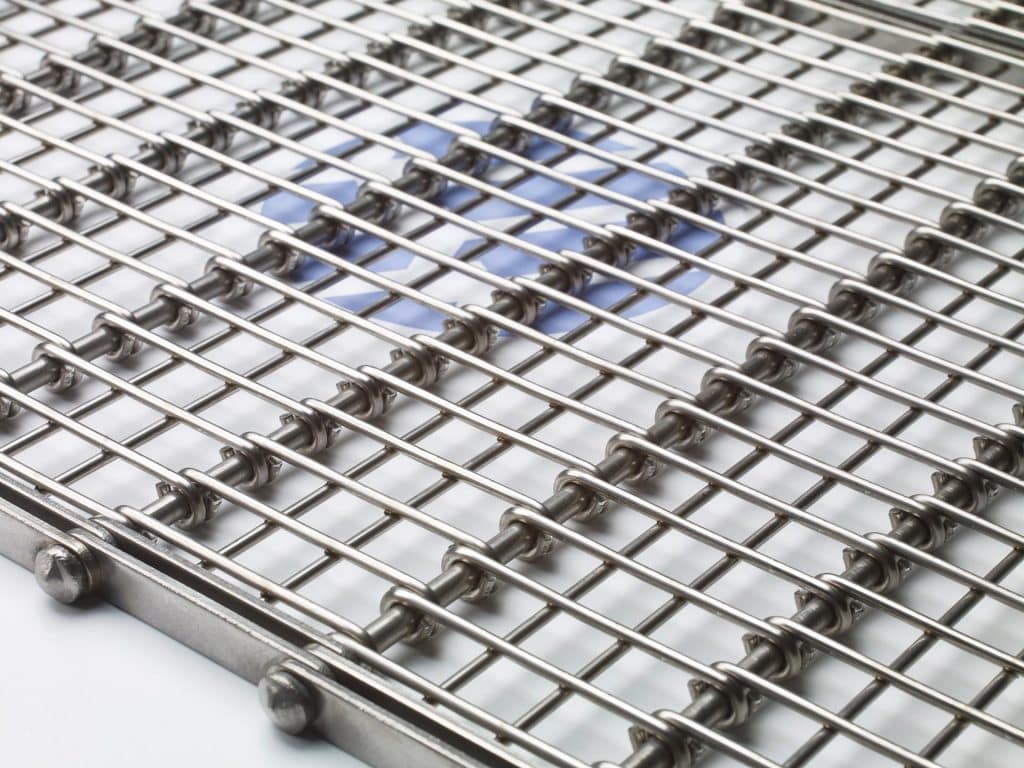
- Eye-Flex® — A heavy-duty modular belt for demanding applications requiring greater strength and carrying capacity. The flat open surface profile makes it suitable for conveying heavy or irregular product loads. Custom configurations are available for specific application requirements.
- Honeycomb Wire Belt — Constructed from formed flat wire strips connected by cross rods, providing a strong, lightweight belt with large open area. Particularly suited to processes involving washing, drying, cooling, and cooking, where maximum airflow or liquid passage through the belt surface is required. Positively driven.
- Cordweave Belt — An extremely dense mesh with very little open area and a flat carrying surface — effectively a belt within a belt. Used for conveying very small items and for applications requiring uniform heat transfer across the carrying surface, such as biscuit and snack baking, bottle annealing, and small component handling. Friction-driven; chain edge variants available.
- Rolled Baking Band — Designed for biscuit and cookie tunnel ovens operating at temperatures up to 310°C. The mesh is passed through a rolling process to produce a completely flat, smooth surface without compromising heat efficiency or airflow. Belts are typically installed in lengths exceeding 100 metres and are friction-driven via a large diameter drum at the oven outfeed. Not recommended for high-fat soft doughs that may flow into the mesh.

Wire Belt Balanced Spiral Woven
Hygienic Design and Cleanability
All Wire Belt products intended for food contact are manufactured in Grade 304 stainless steel as standard, with Grade 316 available for corrosive environments. The open wire construction eliminates the enclosed hollow sections and crevices found in modular plastic belts — features that create biofilm harbouring sites that are difficult or impossible to clean effectively in situ.
The Flat-Flex® design, in particular, was developed with clean-in-place operation as a primary requirement. The belt’s positive drive system means it can be cleaned while running at reduced speed — a significant operational advantage over belts that must be stopped and stripped for cleaning. USDA acceptance confirms the belt meets US Department of Agriculture hygienic design requirements for food and dairy applications, a standard that aligns with the audit expectations of BRCGS-certified facilities.
For applications where CIP is not practical — such as dry powder conveying where water ingress would be damaging — Wire Belt belts can be cleaned out of place or by dry cleaning methods. APS can advise on appropriate cleaning protocols for your specific application.
Planning a processing or packaging project?
Speak with Advanced Packaging Systems about equipment selection, line integration, and local support in New Zealand.
- Local technical and commercial support in New Zealand.
- Obligation-free advice on equipment and line fit.
- Useful next steps, even if your project is still early-stage.
Specifying the Right Belt
Belt selection depends on several interacting factors: product type and weight, process temperature and moisture exposure, required open area, cleaning method, conveyor geometry (including any curves or inclines), and drive arrangement. Selecting on price alone — replacing a worn belt with what appears to be an equivalent — frequently results in shorter belt life or cleaning difficulties that could have been avoided with accurate specification.
APS Technical Sales will work through your application requirements to identify the correct Wire Belt specification, including wire diameter, pitch, edge treatment, and drive type. For replacement belts, APS can assist with measurement and identification to ensure continuity of performance. Contact us to discuss your conveyor belt requirements.