

An industrial paint mixer has one job that matters more than any other: getting pigments, extenders and thickeners fully dispersed into the liquid base, consistently, batch after batch. Opacity, gloss, colour strength and storage stability all depend on how well that step is done, and in many plants it is also the slowest step on the line.
This article covers what dispersion involves, where a conventional agitator struggles, and how the Silverson high shear mixer configurations fit different paint processes. It goes deeper into mixing than our overview of paint and coatings manufacturing equipment, which also covers filtration and screening.

Silverson Ultra Mix Bottom Entry
What Dispersion Actually Involves
Most paint pigments, including titanium dioxide (TiO₂), arrive as powders that have already been milled to their working particle size. Dispersion is therefore not usually about grinding particles smaller. It is about undoing the clumps that form when fine powders are stored, handled and added to a liquid. Silverson’s application guidance on TiO₂ makes the point directly: particle size reduction is not applicable in most cases, but the pigment must be fully dispersed and evenly distributed to reach its full opacity and gloss.
In practice the job has three parts:
- Wetting out. The liquid has to displace the air around each particle. Fine, low-density powders resist this and float on the surface.
- Breaking up agglomerates. Clusters of particles held together by surface forces have to be pulled apart. This needs shear, not just movement.
- Distributing and holding. The separated particles have to be spread through the whole batch and kept apart, which is where the formulation’s dispersants and the base itself do their work.
A mixer that moves the batch well but delivers little shear can do the first and third parts reasonably well. It is the second part that decides how long a batch takes.
Why a Standard Agitator Struggles
A paddle or propeller agitator is good at bulk movement and at keeping a finished batch uniform. Where it runs into difficulty is the powder addition stage:
- Pigment particles tend to re-agglomerate as they hit the water, solvent or resin, and a low shear impeller cannot break them back down efficiently.
- Light powders such as fumed silica float, so they sit on the surface rather than being drawn into the batch.
- As thickeners hydrate and viscosity rises, movement in the tank slows, which makes dispersing the remaining powder harder still.
- Powder has to be added slowly to avoid lumps, which stretches the cycle, adds dust and, in solvent systems, increases solvent loss.
The usual workarounds are longer mixing times, a separate dispersion or milling step, or adding more of an ingredient than the formulation strictly needs. Silverson notes that with fumed silica in particular, manufacturers often overdose the thickener to make up for poor yield from low shear mixing, which in turn makes batches less consistent.

Silverson Inline Mixer
How a High Shear Rotor/Stator Changes the Process
A Silverson high shear mixer uses a rotor turning at high speed inside a close-fitting stator. The rotor draws liquid and powder into the workhead, centrifugal force drives the material out to the narrow gap between the rotor blade tips and the stator wall where agglomerates are broken up, and the mix is then forced out through the stator openings back into the vessel. Fresh material is drawn in at the same time, so in a short cycle the whole batch passes through the workhead many times.
The effect is that wetting out, deagglomeration and distribution happen together rather than in sequence. Silverson’s application reports for paint ingredients list the practical results as faster powder addition with less dust, breakdown of hard agglomerates, the option of a closed system to reduce solvent emissions, and shorter cycles that reduce wear and maintenance.
High shear complements good tank movement rather than replacing it; on larger batches some configurations are designed to work with an existing agitator or anchor stirrer.
Industrial Paint Mixer Options Compared
Which configuration suits a process depends mainly on batch size, the final viscosity, and how much powder has to go in. The Silverson range covers four main approaches:
| Configuration | How it works | Best suited to | Points to check |
|---|---|---|---|
| Batch high shear mixer | Workhead mounted on a shaft and immersed in the vessel. | Small to medium batches, typically up to around 1,500 litres. Can be moved between vessels on a mobile stand. | Sealed units are available where solvent vapour or dust has to be contained. |
| In-line high shear mixer | Mounted in a recirculation loop beside the vessel; product is pumped through the workhead and returned. | Larger batches and retrofits to existing tanks. Aeration-free and can also discharge the vessel. | Needs an efficient in-tank agitator to wet out light powders before they reach the mixer. |
| Flashmix powder/liquid mixer | In-line mixer that forces powder directly into the high shear zone as liquid recirculates. | Large powder loadings, higher viscosity mixes and higher temperatures, with powder added at floor level. | Size to the powder incorporation rate the batch needs. |
| Bottom entry and Ultramix mixers | Workhead mounted in the base of the vessel, or a closed-rotor mixer that pulls powder down from the surface. | Higher viscosity products, often alongside an anchor stirrer or scraper, and powders that tend to raft on the surface. | Bottom entry units are fitted at vessel design or modification stage. |
Each of these is covered in more detail in our articles on the Silverson batch mixer, the inline high shear mixer, the Silverson Flashmix and the Silverson Bottom Entry Mixer.

Silverson Flashmix
Case Study: From Two Working Days to Three Hours
Silverson has published a case from a UK paint manufacturer that shows the scale of the difference. The manufacturer was dispersing four powders, TiO₂, China clay, talc and fumed silica, into a 3,000 litre vessel using an in-tank agitator. Each batch took 16 to 20 hours, or two full working days.
A Silverson Flashmix FMX50 was installed to handle the powder addition. Operators now tip the powders from 25 kg bags into a hopper at ground level, and the same batch is completed in three to four hours. Silverson reports that the plant now produces four times as much product with the same shifts and the same crew, and that the customer is evaluating further units for other applications.
The powders are a typical architectural paint mix of prime pigment, extenders and a thickener, and the change came from how powder enters the batch, not from a new vessel or recipe.
Scaling a Formulation From the Laboratory
Because Silverson uses the same rotor/stator principle and tolerances from laboratory units through to production machines, a dispersion developed at bench scale can be transferred to production with little or no reformulation. For paint developers this matters most with thickeners, where the viscosity result is sensitive to the shear applied. The Silverson L5M-A laboratory mixer is the usual starting point, and the FMX5 is a laboratory-scale version of the Flashmix for trialling powder addition.
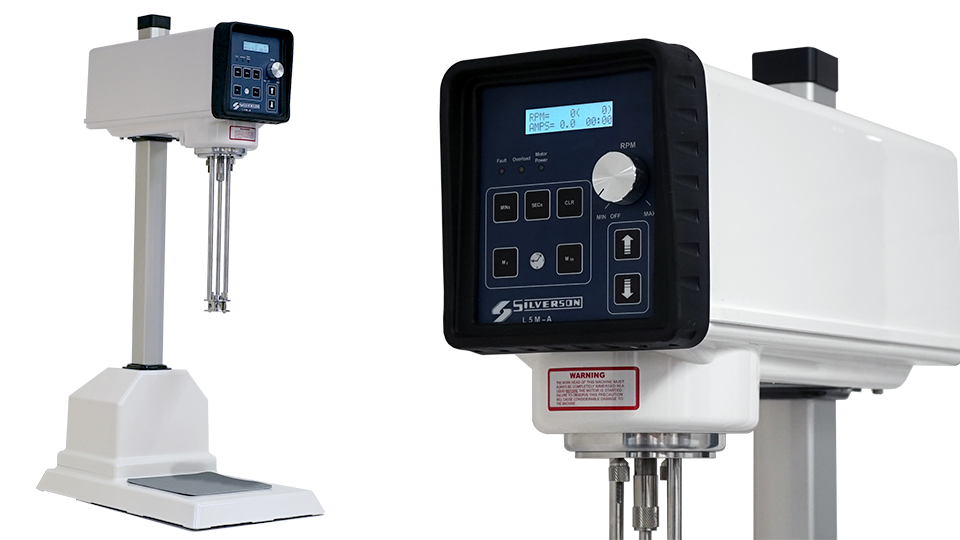
Silverson High Shear Lab Mixer
Choosing an Industrial Paint Mixer: Questions to Answer First
Before comparing machines, it helps to have answers to the following:
- Batch size and vessel. Is the mixer going into an existing tank, or is a new vessel being specified?
- Final viscosity. How thick does the batch get once thickeners have hydrated, and does tank movement fall away at that point?
- Powder loading. How many kilograms of powder go into each batch, how light are they, and how quickly do they need to go in?
- Water or solvent based. Solvent systems may need sealed units, closed-loop operation and suitably rated electrical equipment. Fine dry powders also bring combustible dust and ATEX considerations.
- Abrasion. Are any extenders or pigments abrasive enough to justify hard-faced wear parts?
- Colour changes and cleaning. How often does the line change product, and how quickly does the mixer need to be cleaned between batches?
Mixing Is One Step in the Line
A well-dispersed batch still needs to be checked for skins, unmixed product and contamination before it is filled. Where the specification calls for a finer grind than dispersion can deliver, the mill base goes on to a bead mill or basket mill, covered in our guide to choosing a bead mill or basket mill. Filling into tins, pails and drums is covered in our paint filling machine guide. Self-cleaning filtration after the mixing stage is covered in the overview linked above, along with screening for powder coatings, and the full range for the sector is on our Chemical and Paint industry page.
Advanced Packaging Systems is the New Zealand partner for Silverson and supplies the full range, from laboratory mixers to production batch, in-line and Flashmix systems. Silverson also offers trials, either at its test facilities or on site, so a dispersion can be proven on the actual formulation before equipment is specified. Contact APS to discuss your process or arrange a trial.
Planning a processing or packaging project?
Speak with Advanced Packaging Systems about equipment selection, line integration, and local support in New Zealand.
- Local technical and commercial support in New Zealand.
- Obligation-free advice on equipment and line fit.
- Useful next steps, even if your project is still early-stage.